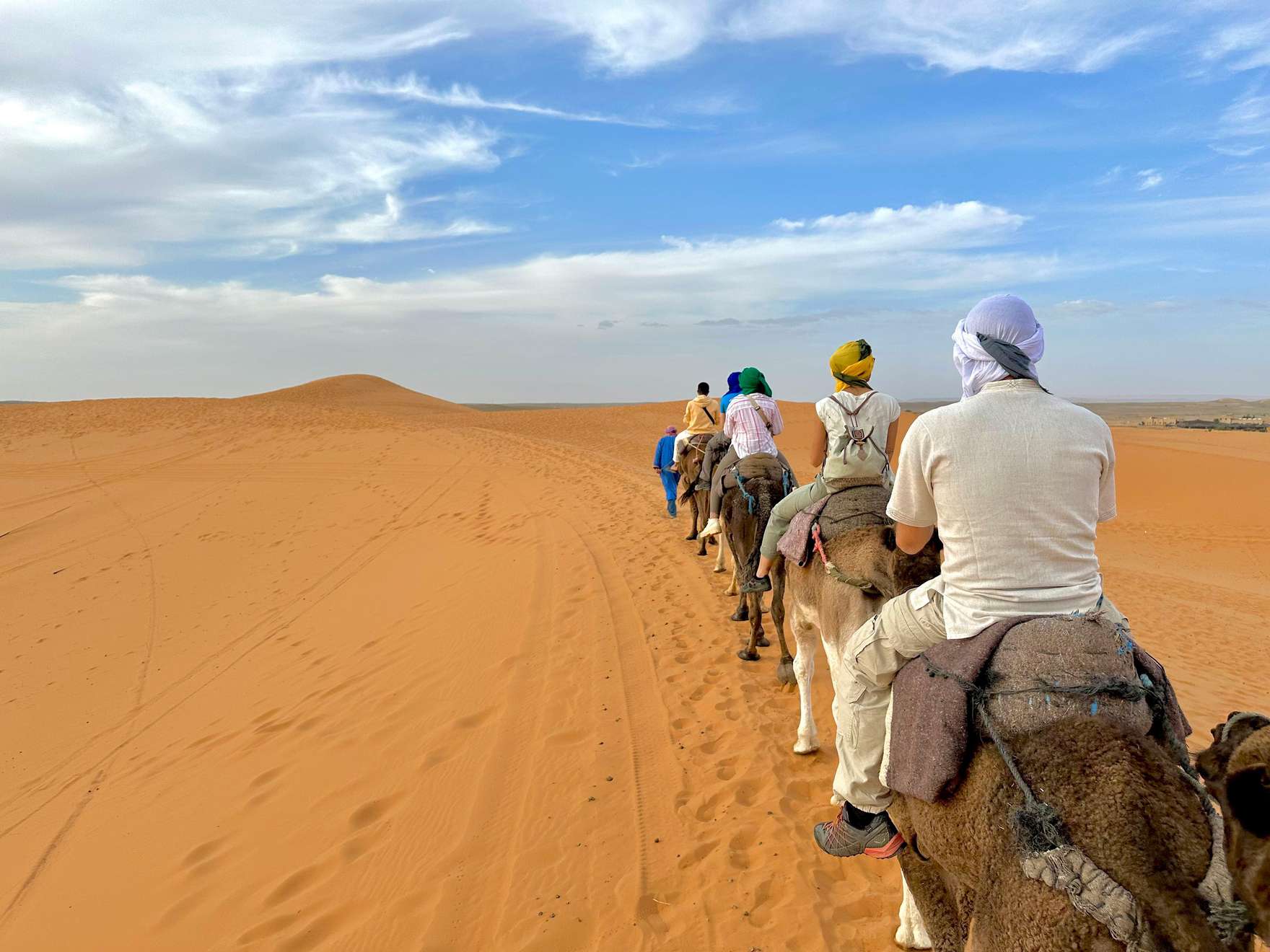
A night in an Erg Chebbi desert camp follows the same shape whether you pay a little or a lot. After a camel trek or a 4x4 ride out of Merzouga village, you reach a tented camp set among the dunes — sand hills that rise up to about 150 m. You watch the sun drop behind the ridges, eat a communal dinner (usually a tagine), sit in near-total silence, look up at a sky with very little light pollution, sleep in a tent, and wake early for sunrise. That core experience is identical across every camp.
The real difference is comfort and privacy. A standard camp gives you a simpler tent, a bed or mattress with blankets, and shared toilet and shower blocks. A luxury camp gives you a larger private tent with a proper bed and linens, a private en-suite bathroom with a hot shower, heating for cold nights, and more space to spread out. Same dunes, same stars, same silence — different bedroom. This guide compares the two honestly so you can match the camp to your budget, your travel companions and the season, without paying for comfort you do not need.
How do you reach the camp from Merzouga, and how long does it take?
Camps sit inside the Erg Chebbi dune field, a short distance from Merzouga village, and you cover the last stretch either on a camel or in a 4x4. A camel trek takes roughly 45 to 90 minutes, depending on how deep into the dunes your camp is placed. A 4x4 transfer is quicker — about 15 to 30 minutes — and is the usual choice for anyone who cannot or would rather not ride.
Getting to Merzouga itself is the long part. From Marrakech it is roughly 560 km and about 9–10 hours by road, crossing the Tizi n'Tichka pass at 2,260 m through the High Atlas. From Fes the drive is shorter — around 470 km and 7–8 hours. Because of those distances, almost nobody visits the desert as a day trip: most people arrive as part of a 2 or 3-day desert tour, sleeping one or two nights in the dunes. If you are weighing the routes, our guide on how to get to the Sahara from Marrakech breaks down the drive and the common itineraries. Flying cuts some of it: Errachidia airport (ERH) is about 55 km from Merzouga, though most travellers still come overland from Marrakech (Menara, RAK).
What does a standard desert camp include?
A standard camp covers the essentials and little more, and that is the point. Expect canvas or Berber-style tents with simple beds or floor mattresses, blankets, and a communal dinner tent where everyone eats together. Bathrooms are shared toilet and shower blocks a short walk from the sleeping tents. Electricity is usually limited — solar lamps, or a generator that runs for a few hours in the evening — so plan to charge devices before you arrive and bring a headtorch or power bank.
This tier suits budget travellers, backpackers, and anyone who cares more about the setting than the furnishings. You are still sleeping in the same dunes, eating the same style of Moroccan food and seeing the same night sky as guests paying several times more. What you give up is privacy and a few creature comforts. On the coldest winter nights, the thinner tents and shared facilities are the honest downside — you feel the temperature more. If that trade-off appeals, a budget-friendly 3-day Sahara tour is built around exactly this kind of camp.
What do luxury desert camps add over standard ones?
Luxury camps sell comfort and privacy, not a better location — the dunes are the same. The upgrades are concrete: larger private tents with real beds, proper linens and rugs; a private en-suite bathroom with a hot shower and a flushing toilet inside your own tent; heating or better insulation for cold nights; and multi-course meals rather than a single shared dish. Many add seating areas, carpets and lanterns, and at the higher end a few camps have small plunge pools.
The practical value of all this shows up at night and in the cold months. A private bathroom means you are not crossing the sand in the dark; insulation and heating mean a January night on the dunes is manageable rather than something to endure. If a private tent with an en-suite is what you are after, our Sahara tour with a private tent page explains what that tier typically includes. Just keep the honesty rule in mind: luxury buys comfort, warmth and quiet — it does not buy a different desert.
How cold does the Sahara get at night, and what should you pack?
The Sahara has a large diurnal temperature range — the gap between day and night is wide — so desert nights are far colder than the daytime heat suggests. Near Merzouga in winter (December–February), January days sit around 19°C while nights fall to roughly 6°C, and it gets colder still on the open dunes, sometimes approaching freezing. In summer, July days often exceed 40°C and can pass 45°C on the sand, while nights stay warm — commonly around 20–25°C. This is normal for a hot desert climate, as Britannica's overview of the Sahara explains.
So pack for both extremes, whatever the season:
- Layers — a t-shirt for the day, plus a fleece or jumper for the evening.
- A warm jacket if you travel between roughly November and March; nights are genuinely cold.
- Sun protection — hat, sunglasses, high-SPF sunscreen and plenty of water for the daytime.
- Closed shoes for sand, plus sandals for camp; sand gets everywhere, so a small bag helps.
- A headtorch or power bank, since camp electricity is limited.
Our full what to pack for a Sahara desert tour checklist goes deeper, and the packing advice applies equally to standard and luxury camps — a heated tent still opens onto a cold dune.
What happens over a typical evening and morning at camp?
The rhythm is the same in every camp; luxury simply makes each step softer. Here is how a night usually unfolds:
- Late afternoon: you arrive before sunset, drop your bag and are welcomed with mint tea.
- Sunset: you climb a nearby dune to watch the light change over the ridges — the walk up soft sand is short but tiring.
- Evening: a communal dinner of tagine, couscous and soup, often followed by Berber drumming around a fire.
- Night: with very low light pollution, the Milky Way is visible on clear nights, so people linger outside before bed.
- Early morning: an early wake-up for sunrise over the dunes, then breakfast before the return trek to Merzouga.
In a standard camp you do all of this with simpler food and shared facilities; in a luxury camp the meals have more courses, the seating is more comfortable and you retreat to a warm private tent. The sunset, the drumming and the stars, though, cost the same everywhere. To learn about the Berber culture behind the music and hospitality, the Moroccan National Tourist Office is a reliable starting point.
Is a standard or luxury camp better value for your trip?
Honestly, both deliver the desert — the question is what you personally need on top of it. A standard camp costs less and gives you the same dunes, stars and silence, which for many travellers is the whole reason to come. A luxury camp buys privacy, a private bathroom, warmth and better food — comforts that matter most for couples, families, cold-season trips, honeymoons and light sleepers who will not enjoy a chilly night in a shared-facility tent.
A useful way to decide: picture your worst-case night. If a cold walk to a shared toilet and a thin mattress would ruin the experience for you, pay for luxury. If it would not bother you, save the money and spend it elsewhere on your trip. Because live prices and ratings shift constantly, we do not quote figures here — compare current, verified prices and reviews on the desert tours and compare pages instead of trusting a number in an article. It is also worth reading our take on whether the Sahara desert tour is worth it before you commit either way.
Who should choose which camp, and what are the trade-offs?
Here is the short version, by traveller type:
- Solo travellers, backpackers and social, budget-minded groups → standard. Shared camps are cheaper and more sociable, and the basic setup is part of the adventure.
- Couples, families with children, older travellers, honeymooners and winter visitors → luxury. A private tent, an en-suite bathroom and heating remove the friction that turns a memorable night into an uncomfortable one.
Some trade-offs apply to both tiers. Camps are remote, and the last stretch is soft sand reached by camel or 4x4, so access is limited for anyone with reduced mobility — even a luxury camp cannot pave the dunes. Connectivity is minimal everywhere: mobile signal is patchy and Wi-Fi is rare. And the long drive to Merzouga is unavoidable regardless of which tent you sleep in. If you are still deciding on the overall style of trip, private vs shared Sahara desert tour is a helpful companion read, since the camp tier and the transport style often go together.
Before you book, match the camp to the exact night you want — cold-season warmth, a private bathroom, or simply the cheapest way to sleep under the stars — and then check what is actually available on the 3-day Sahara tour from Marrakech to Merzouga page, where the standard and upgraded camp options sit side by side.
Frequently asked questions about staying in an Erg Chebbi desert camp
Is there a bathroom in a desert camp?
Yes, but it depends on the tier. Standard camps have shared toilet and shower blocks a short walk from the tents. Luxury camps have a private en-suite bathroom inside your own tent, usually with a hot shower and a flushing toilet.
Is Wi-Fi available at a desert camp?
Rarely. Connectivity is limited across the whole Erg Chebbi area, and even most luxury camps have weak or no Wi-Fi. Mobile signal can appear in patches but is unreliable, so treat a night in the dunes as time offline.
Is it safe to stay in a Sahara desert camp?
Staying overnight in an organised Erg Chebbi camp is generally considered safe. Camps are run by local staff, the main practical risks are the cold at night and the heat by day, and standard travel precautions apply. For current entry and travel advice, check the Moroccan National Tourist Office.
What is the best time of year to visit the Erg Chebbi desert?
Spring (March–May) and autumn (September–November) offer the mildest temperatures, avoiding both the summer heat above 40°C and the cold winter nights. Winter is quieter and the days are pleasant but nights are cold; summer is hot but nights stay warm. Our best time to visit the Sahara desert guide covers each season in detail.
Can you visit a desert camp with kids, and do you have to ride a camel?
Yes to both. Families are common, and a luxury camp with a private tent and bathroom is usually the more comfortable choice with children. You do not have to ride a camel — a 4x4 transfer reaches the camp in about 15–30 minutes and is the standard alternative for kids, older travellers or anyone who prefers not to ride.