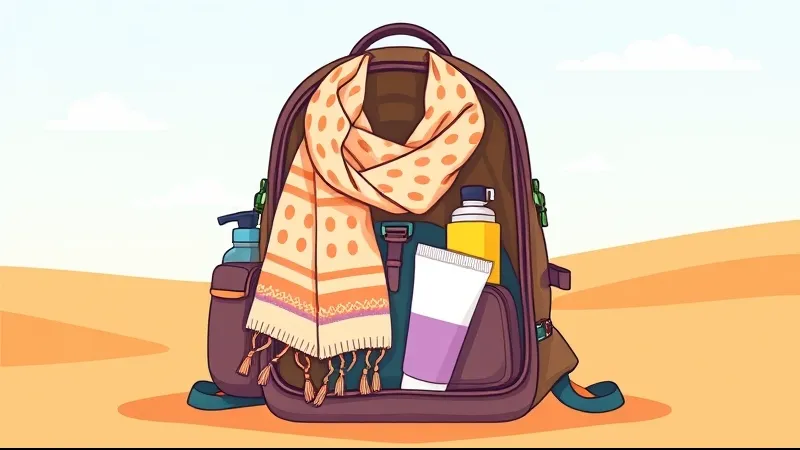
For a Sahara desert tour from Marrakech to Merzouga, pack for two climates in one trip. The core list is the same in every season: layered clothing you can add and remove, strong sun protection (wide-brim hat, high-SPF sunscreen, UV sunglasses), one warm layer for the desert camp night even in July, closed shoes plus easy-off sandals, a refillable water bottle, a power bank, a headlamp, and a small backpack for the overnight. The reason is Erg Chebbi's extreme diurnal temperature swing: the same dune that reads 45°C on the sand at midday can cool by 20°C or more before dawn, so you dress for heat by day and cold by night regardless of the calendar.
One more planning note shapes everything you carry. Marrakech to Merzouga is roughly 560 km and about 9–10 hours by road each way, over the Tizi n'Tichka pass (2,260 m). Pack a compact day bag with your overnight kit, water and electronics separately from your main luggage, because only the small bag comes with you to the camp.
Why does the desert get so cold at night even in summer?
The desert gets cold at night because dry, cloudless air lets the day's heat escape back into space quickly after sunset. During the day the sand and rock absorb intense solar radiation. At night, with almost no water vapour or cloud cover to trap that heat near the ground, it radiates away fast — a process that produces the large day-to-night gap climatologists call the diurnal temperature range. Humid, cloudy places barely cool overnight; arid deserts like Erg Chebbi can shed 20°C or more between afternoon and pre-dawn.
This single fact justifies the most-forgotten item on any list: a warm layer, even in high summer. Travellers who pack only for the heat they feel getting off the vehicle are the ones shivering at 4 a.m. You can read more about how deserts lose heat at night from the NASA Earth Observatory.
What are the actual temperatures in Merzouga by season?
Merzouga sits in a hot desert (Köppen–Geiger "BWh") zone, so the numbers swing hard by season and by hour. Use these as a compact reference:
- Summer (June–September): daytime typically above 40°C, and July heat on open sand can feel hotter still. Nights stay warm-ish but still cool to roughly 20–25°C.
- Winter (December–February): pleasant days around 15–20°C — January averages about 19°C by day — but nights drop to roughly 0–8°C, and around 6°C is normal, colder on the exposed dunes, occasionally near freezing before dawn.
- Spring and autumn (March–May, October–November): the mildest windows, with daytime around 25–30°C and comfortable nights.
Because the gap between a summer midday and a winter pre-dawn can span 40°C or more, layering is the whole strategy. For a fuller month-by-month breakdown, see our guide to the best time to visit the Sahara desert in Morocco.
What should you pack for a summer Sahara tour (June to September)?
For a summer tour, pack to cover your skin from the sun rather than to bare it. Counterintuitively, loose long sleeves keep you cooler and safer than a tank top under direct desert sun. Your summer kit:
- Loose, light long-sleeve shirts in cotton or linen
- A wide-brim hat that shades the neck
- High-SPF sunscreen (SPF 30–50), reapplied through the day
- UV-blocking sunglasses
- A lightweight scarf or chèche for wind and blowing dust
- Electrolyte tablets to replace what you sweat out
- At least 2–3 litres of water per person per travel day
Even in July, bring one light sweater or fleece for the camp night — nights of 20–25°C feel cold once the day's heat is gone and you have been sweating for hours. Expect a sharp contrast, too, between the air-conditioned vehicle on the long drive and the open dunes: you will peel layers off in the car and pull them back on at the top of the sand.
What should you pack for a winter Sahara tour (December to February)?
For a winter tour, the daytime is genuinely pleasant but the night is the challenge, so pack a full warm-layer system for the camp. What to bring:
- A thermal base layer (top and bottoms)
- A fleece or light down mid-layer
- A windproof outer jacket
- A warm hat and gloves for the evening
- Thick warm socks, plus a beanie to sleep in
Camps provide beds and heavy blankets, but pre-dawn temperatures near freezing still catch people out — the cold radiates up through the ground and in through any gap. A beanie and warm socks in your sleeping kit make the difference between resting and lying awake. During the day you will strip back down to a shirt in the sun, so the winter skill is simply layering up and down as the hours pass.
What clothing works best for a camel ride and the dunes?
For the camel trek and walking the dunes, choose long trousers, closed shoes and a head wrap. Long trousers matter most on the camel: a saddle rubs, and bare legs chafe within minutes. Practical dune clothing:
- Long, breathable trousers to prevent saddle chafing
- Closed shoes or trainers for the walk to and around camp
- Easy-off sandals for camp, so you can shake sand out without unlacing boots
- A chèche or turban to wrap your head and neck against sun and blowing sand
Skip shorts for the camel ride and skip flip-flops for walking the dunes — the sand can be scorching in summer and awkward to climb in loose footwear. Modest, breathable fabrics also sit more comfortably with local Berber culture, where covering shoulders and knees is the everyday norm. The Erg Chebbi dunes rise up to about 150 m, so anything you climb, you climb in soft sand.
What electronics and gadgets should you bring to the desert camp?
Bring a power bank first — many camps run on limited or solar-only electricity, so a wall socket is not guaranteed. A sensible electronics kit:
- A charged power bank (your main overnight power source)
- A headlamp or torch for moving around a camp with no street lighting
- Your phone with offline maps downloaded before you leave signal
- A universal or EU (Type C/E) plug adapter
- A camera with a spare battery — cold nights drain batteries faster
- A small dust-proof pouch or zip bag for anything with a lens or a port
Mobile signal at the Erg Chebbi camps is weak or absent, so treat the camp as offline: download your maps, playlists and any tickets in advance. Fine sand gets into everything, and a cheap zip bag protects a camera far better than a jacket pocket.
What toiletries, medication and health items are essential?
The desert is dry and washing water at camp is limited, so prioritise items that handle dryness and keep you clean without a tap. Pack:
- Lip balm with SPF and a moisturiser for dry air
- Hand sanitiser and a pack of wet wipes
- A basic first-aid kit and any personal medications (in their original packaging)
- Motion-sickness tablets for the winding High Atlas road over the Tizi n'Tichka
- Rehydration salts for hot travel days
The road between Marrakech and the desert is long and full of switchbacks, and the passenger who never gets carsick at home sometimes does here — motion-sickness tablets are cheap insurance. Before any trip, it is worth checking official travel-health guidance for Morocco, such as NHS Fit for Travel or the CDC's Traveler's Health pages.
What should you leave in Marrakech and not bring to the camp?
Leave your large suitcase at your Marrakech riad or hotel and take only a small overnight backpack to the camp. Most riads store luggage for free while you are in the desert, and the practical reason is the final approach: the last stretch to camp is by camel or 4x4, where a hard-shell suitcase is a liability and there is nowhere to wheel it. The two-bag strategy — main luggage stays behind, small day pack comes with you — is tied directly to the ~9–10 hour drive and the camel transfer at the end.
Also leave behind heavy valuables, excessive cash and anything you would be upset to get sandy. You need a change of clothes, your warm layer, toiletries, electronics and water for one or two nights — nothing more. Our getting there guide covers how the transfer works once the road runs out.
How much water should you carry on the drive and at the camp?
Aim for roughly 2–3 litres of water per person per day in the desert, and more in summer heat. The drive itself is long with limited stops, so start it with water already in the vehicle rather than counting on roadside shops. At camp, bottled water is provided, but carrying your own refillable bottle means you top up and drink steadily instead of waiting for the next bottle to appear.
Dehydration creeps up quietly in dry air because your sweat evaporates before you notice it. Health authorities consistently advise increasing fluid intake in hot climates; the NHS covers the basics of staying hydrated. Electrolyte or rehydration tablets help on the hottest days, when plain water alone is not enough.
If you are still choosing between itineraries, our comparison of the 3-day Sahara tour from Marrakech to Merzouga lays out exactly how many nights you pack for and what the camp stop involves — the honest starting point before you finalise your bag.
Frequently asked questions
Do I need a sleeping bag for the desert camp?
No. Camps provide beds, mattresses and blankets, so a full sleeping bag is unnecessary and bulky. In winter, a lightweight sleeping-bag liner adds warmth and a clean layer against your skin for very little weight — a reasonable extra for the cold months, optional the rest of the year.
Is there a shower at the desert camp?
It depends on the camp. Luxury and private camps usually have private bathrooms with showers, while standard and budget camps offer only basic washing facilities or shared bathrooms with limited water. Assume water is scarce and pack wet wipes and hand sanitiser so you are comfortable either way.
Can I charge my phone at the camp?
Often only partially. Many camps rely on solar power or run a generator for a few hours, so charging can be slow, shared or unavailable overnight. Bring a fully charged power bank and treat it as your primary source of power for the trip.
How cold does it really get in the Sahara in winter?
Winter nights in Merzouga typically fall to around 0–8°C, with pre-dawn temperatures close to freezing on the exposed dunes. January averages about 19°C by day and roughly 6°C at night, but the wind chill on open sand makes it feel colder — hence the thermal layer, hat and gloves.
Do I need to cover up for cultural reasons?
Modest, breathable clothing is recommended. Covering shoulders and knees is the everyday norm in rural Berber communities, and loose layers also protect you better from sun and blowing sand. You do not need special dress, just clothes that lean modest and practical over revealing.
Sources
- Moroccan National Tourist Office (visitmorocco.com) — official tourism and regional information
- UNESCO World Heritage Centre — Aït Ben Haddou — Moroccan desert-route heritage context
- NASA Earth Observatory — desert diurnal temperature range and how deserts cool at night
- NHS Fit for Travel — Morocco and CDC Traveler's Health — Morocco — travel-health and hydration guidance
Live tour prices, durations and ratings come from the GetYourGuide widgets on our tour pages, not from this article.