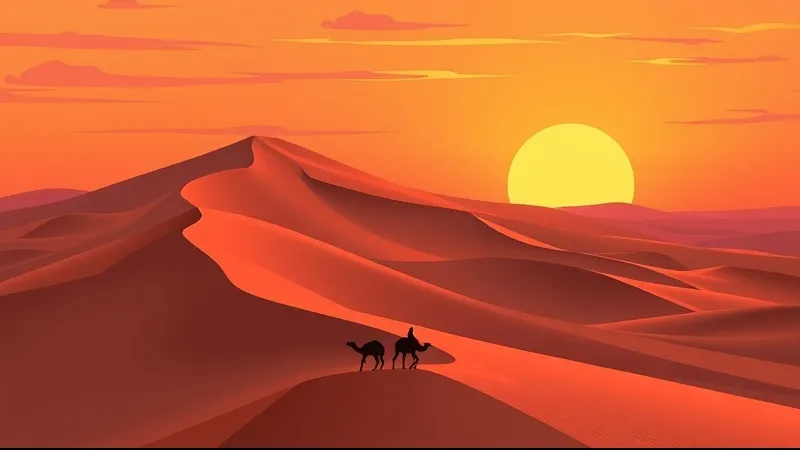
The best months for the classic 3-day Marrakech–Merzouga tour are March to May and September to November. In those windows daytime highs in Merzouga sit around 25–30°C and nights stay mild, which is comfortable for camel treks, dune walks and sleeping in a desert camp. Summer (June–August) is the hot extreme: daytime highs regularly pass 40°C and the sand can feel far hotter. Deep winter (December–January) flips it: pleasant, sunny days but desert nights that fall close to 0°C.
There is no genuinely bad time to see Erg Chebbi — only trade-offs between heat, crowds and price. Spring and autumn give you the easiest all-round comfort. Winter rewards you with clear, star-heavy skies and quieter dunes if you pack for the cold. Even summer works if you accept a dawn-and-dusk rhythm and drink far more water than you think you need. This guide breaks down the weather month by month, explains the day–night swing that surprises most first-timers, and matches each season to the 3-day Marrakech to Merzouga tour.
What is the weather like in Merzouga month by month?
Merzouga and the Erg Chebbi dunes sit in a BWh hot desert climate under the Köppen–Geiger classification: very hot summers, mild winters and little rain. The figures below are approximate climate normals for the region, drawn from the WMO World Weather Information Service and the Moroccan national weather service (Direction Générale de la Météorologie). Treat them as typical ranges, not guarantees — desert weather varies year to year.
- January — about 18–19°C day / 5–6°C night
- February — about 21°C day / 7°C night
- March — about 25°C day / 10°C night
- April — about 29°C day / 14°C night
- May — about 34°C day / 18°C night
- June — about 39°C day / 23°C night
- July — about 41°C day / 26°C night
- August — about 40°C day / 25°C night
- September — about 35°C day / 21°C night
- October — about 29°C day / 15°C night
- November — about 23°C day / 9°C night
- December — about 19°C day / 6°C night
Two patterns jump out. First, the sweet spots are the shoulders — March, April, October and November — where days are warm but not punishing and nights are cool rather than cold. Second, nights are always much colder than the daytime figure suggests, and on the open sand of the dunes it can feel several degrees colder still than the town readings.
How hot does the Sahara get in summer near Marrakech?
Summer (June–August) is genuinely hot: daytime highs in Merzouga regularly exceed 40°C, and on the sun-exposed sand of Erg Chebbi the early afternoon feels hotter still. Add the occasional dust-laden sirocco-type wind blowing off the desert interior and midday becomes a time to rest in shade, not to walk dunes.
This is why summer tours run on a dawn-and-dusk schedule. Camel treks and dune walks are timed for the first hours after sunrise and the last hours before sunset, when the sand has cooled and the light is softer; the middle of the day is spent under cover at the camp or auberge. It works, but it compresses the active part of the trip into two short windows.
Hydration is the non-negotiable part. In this heat you lose water fast without feeling it, so plan on drinking well beyond thirst — several litres across the day — and add electrolytes if you are sweating heavily. A head covering and high-factor sun protection matter more here than anywhere else in Morocco. The Morocco National Tourist Office markets the desert year-round, but summer is the season that most rewards planning around the clock rather than the calendar.
How cold do desert nights get in winter?
Winter days (December–February) are mild and sunny — around 16–20°C, pleasant for walking — but the temperature drops sharply after sunset, and camp nights on the dunes commonly fall to 0–5°C, occasionally below. January is the coldest month, at roughly 19°C by day and about 6°C at night in town, colder out on the sand.
That wide day-to-night swing is normal for arid climates. Dry desert air holds very little moisture, so there is nothing to trap the day's heat once the sun goes down; the ground radiates it straight back to a clear sky and the temperature falls quickly within an hour or two of sunset. It catches people out because the afternoon can feel almost warm.
For a winter night in a desert camp, pack in layers: a base layer, a warm mid-layer or fleece, and an insulated jacket you can sleep in comfortably. Add a hat, since a lot of heat escapes through the head, plus gloves and warm socks. Camps provide thick blankets, but the walk to watch the stars — the real reason to come in winter — is where the cold bites. Our full Sahara packing guide breaks this down item by item.
When is the Sahara desert least crowded?
The desert is at its quietest in late November, early December and from late January into February. Demand peaks around Easter, the Christmas–New Year holidays and throughout October, when European visitors combine mild weather with school and public holidays. Spring and autumn in general are busier than winter simply because the weather is easiest.
The trade-off is straightforward. The quiet windows give you emptier dunes, calmer camps and generally softer prices, but they overlap with the coldest nights of the year. The busy windows give you the most comfortable temperatures but more vehicles on the same roads and more tents in the same dune fields. If your priority is solitude and value, aim for the shoulder edges of winter; if it is warmth and easy nights, accept the crowds of spring and autumn. Neither is wrong — it depends on what you are optimising for.
How long is the drive from Marrakech to Merzouga?
Marrakech to Merzouga is roughly 560 km and about 9–10 hours by road each way, which is exactly why the classic tour is spread over three days rather than crammed into a rushed there-and-back. The route climbs the High Atlas over the Tizi n'Tichka pass (2,260 m), then works east through the UNESCO-listed kasbah of Aït Benhaddou, the Dadès and Todra gorges, and the palm-lined valleys of the pre-Sahara before reaching the dunes.
Spreading it over three days turns a long transfer into the trip itself: you break the driving with real stops instead of staring at the road for ten straight hours. Weather mainly affects the mountain leg. In winter, snow can fall on the High Atlas passes, and the Tizi n'Tichka is occasionally slowed or briefly closed after heavy snowfall, so winter tours sometimes adjust timing on that stretch. From spring through autumn the passes are clear and the drive is simply long, not difficult. Most travellers arrive via Marrakech Menara (RAK); Errachidia airport (ERH) is about 130 km from Merzouga and Ouarzazate (OZZ) 5–7 hours away by road, but the classic tour is built around Marrakech. For live prices and ratings, check the comparison pages rather than any figure quoted here — those come from the GetYourGuide widgets on the tour pages, not fixed numbers. If you want the logistics in more depth, see getting there.
When is the classic 3-day tour from Marrakech at its best?
For the classic 3-day Marrakech–Merzouga round trip, spring (March–May) and autumn (September–November) are the strongest all-round seasons: comfortable dunes, clear High Atlas passes, and camp nights that are cool rather than cold. Each season changes the character of the trip:
- Spring — green valleys and flowing gorges after the winter rains, warm days, mild nights. The most balanced choice.
- Autumn — date harvest in the palm groves, warm sand, and some of the mildest evenings of the year. Just as comfortable as spring, often a touch warmer.
- Winter — cold, star-clear nights and the emptiest dunes, with sunny days for the drive; you trade warmth for solitude and pack accordingly, and keep an eye on snow over the passes.
- Summer — activity narrows to dawn and dusk, with the heart of the day spent in shade. Doable, cheaper, quieter, but built around the clock.
If you want a single answer: aim for April–May or October–November and you get the easiest version of the whole experience.
What should you pack for each season in the desert?
Pack for the season and the day–night swing, not just the daytime forecast. A quick reference:
- Summer (Jun–Aug): high-factor sunscreen, sunglasses, a head covering or scarf, light long-sleeved clothing, electrolyte sachets and far more water capacity than you expect. A light layer for the cooler dawn.
- Winter (Dec–Feb): thermal base layer, fleece or wool mid-layer, an insulated jacket warm enough to sleep in, a hat, gloves and warm socks. Days are mild, so also pack lighter clothing for the drive.
- Spring & autumn (Mar–May, Sep–Nov): layers you can add and shed, plus a windproof outer layer — spring in particular brings dust-carrying winds off the desert. A warm top for the evening covers the cooler nights.
Year-round: closed shoes for the dunes, a scarf for sun and blowing sand, and a power bank, since camps have limited electricity.
If spring or autumn suits your plans, that is the season the 3-day Merzouga desert adventure is built around — compare the options and pick the format that matches how much comfort and privacy you want.
Frequently asked questions
Can you visit the Sahara in summer?
Yes, but plan around the heat. Daytime highs regularly exceed 40°C, so camel treks and dune walks happen at sunrise and sunset while the middle of the day is spent in the shade. Bring serious sun protection and drink well beyond thirst.
Does it rain in Merzouga?
Very rarely. Merzouga sits in a hot desert (BWh) climate with only a handful of rainy days a year, mostly as brief showers in spring or autumn. Sudden downpours can occasionally cause flash flooding in the gorges, but dry, clear days are the norm.
Is the desert cold at night in spring?
Spring nights are cool rather than cold — roughly 10–18°C depending on the month, warmer than winter but still a sharp drop from the daytime high. A warm layer for the evening is enough; you do not need full winter gear.
When are the dunes best for photography?
At sunrise and sunset, when low-angle light rakes across the sand, deepens the colour and throws long shadows down the ridges of Erg Chebbi. Midday light is flat and harsh by comparison. These golden windows are also the coolest, most comfortable hours to be out.
Do the High Atlas passes close in winter?
The Tizi n'Tichka pass (2,260 m) stays open most of the winter but can be slowed or briefly closed after heavy snowfall. Tours crossing in December–February sometimes adjust timing around conditions, so build in a little flexibility if you travel then.
Sources
- Direction Générale de la Météorologie du Maroc (Moroccan national weather service) — national climate and forecast data
- World Meteorological Organization — World Weather Information Service — official climatological normals
- Köppen–Geiger climate classification — BWh hot desert zone
- Morocco National Tourist Office (ONMT) — official tourism information
- UNESCO World Heritage Centre — Aït Benhaddou — World Heritage listing
- Office National Des Aéroports (ONDA) — Moroccan airports