A 2-day Sahara tour from Marrakech to Zagora is, in practical terms, a two-day road trip with one night in the desert attached to the end of it. You cover about 360 km each way on the N9, spend about 13–14 hours in a minibus or 4x4, and get around 3–4 hours of genuine sightseeing along the way. What follows is a breakdown of how those two days are actually distributed, what the sand near Zagora really looks like, and which travellers this format suits.
What do you actually get on a 2-day Sahara tour from Marrakech to Zagora?
You get five things: the crossing of the High Atlas at the Tizi n'Tichka pass (2,260 m), a stop at the UNESCO-listed ksar of Aït Benhaddou, a brief pass through Ouarzazate, a drive down the Draa Valley palm corridor, and a short camel ride into a fixed camp near Zagora with dinner, one night under canvas and sunrise the next morning. You do not reach Erg Chebbi at Merzouga. That requires a 3-day tour, because Marrakech to Merzouga is roughly 560 km and about 9–10 hours by road each way over the same pass.
The honest framing: this is a High Atlas and pre-Sahara road trip with a desert night bolted on, not a dune expedition. It suits travellers who have exactly two free days in Marrakech, want to see the mountain and oasis landscapes, and accept that the sand at the end is modest. It does not suit anyone whose mental image of the Sahara is a horizon of large, unbroken dunes — that image belongs to Erg Chebbi or Erg Chigaga. Road distances on the national network are published by the Ministère de l'Équipement et de l'Eau, which is the reference for the N9 corridor described here.
How long is the drive from Marrakech to Zagora, and what does the road look like?
About 360 km each way, typically 6.5–7.5 hours of driving including comfort and photo stops. The whole route follows the N9, the historic Marrakech–Ouarzazate–Zagora axis.
The first two hours are the hardest work. The road climbs out of the Haouz plain into the High Atlas and crosses at Tizi n'Tichka, 2,260 m, on a sequence of switchbacks with long drops on the outside edge. The N9 has been widened and partly realigned over recent years, which has cut journey times and removed some of the worst bottlenecks, but it remains a two-lane mountain road shared with freight traffic. Expect overtaking, expect to be overtaken, and expect the ascent and descent to feel considerably longer than the map suggests.
Winter matters here. Snow and ice can close or restrict the pass for short periods between roughly December and March. Before travelling in winter, check pass and road status with the Ministère de l'Équipement et de l'Eau and the forecast with the Direction Générale de la Météorologie. Operators occasionally reroute via Agadir or postpone departures; that is a normal response, not a red flag.
How are the two days actually split between driving, stops and desert time?
Here is the typical shape of the two days. Times vary by operator and season, but the proportions rarely do.
Day 1
- 07:00–08:00 — Pickup in Marrakech (riad, hotel or a central meeting point)
- 08:00–10:00 — Climb to the Tizi n'Tichka pass, roughly 2 hours with one short break
- 10:30–12:00 — Aït Benhaddou: about 1 hour on site, often 45–90 minutes including lunch
- 12:30–13:00 — Ouarzazate: photo stop, roughly 30 minutes
- 13:00–16:30 — Agdz, then the Draa Valley to Zagora, with one or two roadside stops
- 17:00–18:00 — Camel ride to camp, 45–60 minutes
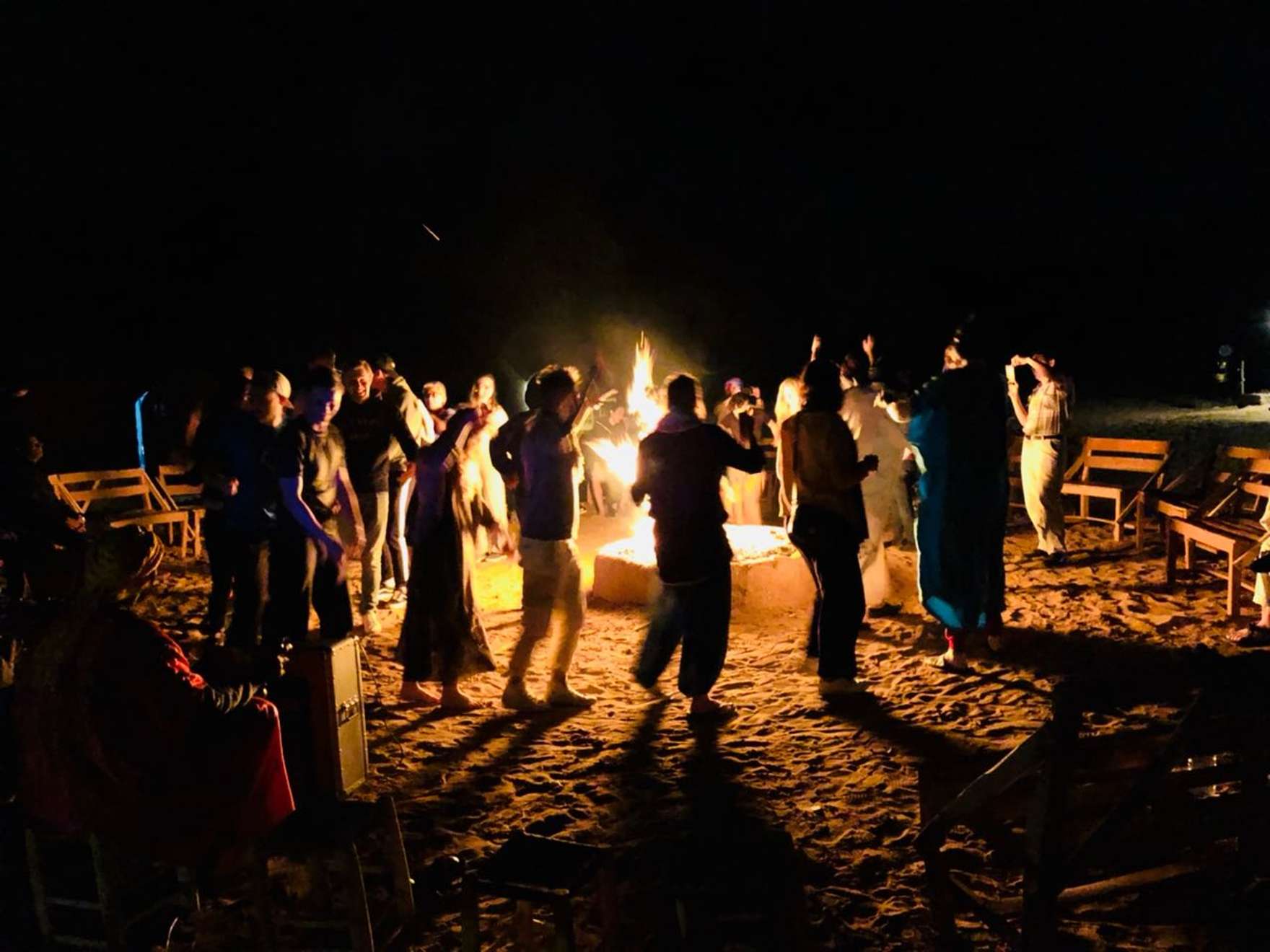
- 19:30 onwards — Dinner, drum music, overnight in the camp
Day 2
- 06:00–08:00 — Sunrise (time varies by season), breakfast, return to the vehicle
- 08:30–19:00 — Return drive to Marrakech via the same N9 corridor
The two-day split, rounded honestly:
- Driving: roughly 13–14 hours across both days
- At the camp, including sleep: roughly 12–14 hours
- Actual sightseeing on foot: roughly 3–4 hours
- Camel riding: 45–60 minutes each way at most, often one-way only
- Remainder: meals, breaks, pickup logistics
That ratio is the single most useful thing to know before booking. Around 30% of your waking time is spent moving through landscape you see through a window.
Are the Zagora dunes real Sahara dunes?
They are real sand, but they are not an erg. The sand fields near Zagora — Tinfou, about 25 km south, and Erg Lehoudi, roughly 15–20 km north-west — are small isolated dune systems typically a few tens of metres high, sitting in a stony plain. Erg Chebbi at Merzouga, by contrast, is a continuous sand sea whose crests are reported up to around 150 m.
The geomorphology explains the gap. A hamada is a bare rocky plateau; a reg is a flat, gravel-covered desert surface; an erg is a large accumulation of wind-blown sand with organised, migrating dune chains. The Zagora area is mostly hamada and reg with sand patches; Merzouga and Chigaga are true ergs. Satellite imagery of Moroccan sand seas published by NASA Earth Observatory makes the contrast obvious at a glance, and the regional landscape context is documented through UNESCO's Man and the Biosphere programme, which covers the Oases of Southern Morocco Biosphere Reserve.
None of this makes Zagora worthless — the light, the silence and the star field are the same. It simply means the photographs you take will not look like the ones that sold you the trip.
What is Aït Benhaddou and how much time do you get there?
Aït Benhaddou is a fortified earthen village (ksar) on the old caravan route between the Sahara and Marrakech, inscribed on the UNESCO World Heritage List in 1987 under reference 444. Its towers and houses are built in rammed earth and adobe over a stone base, a technique that requires continual maintenance and is itself part of what UNESCO protects.
On a 2-day Zagora tour you usually get 45–90 minutes, frequently with lunch inside that window. That is enough to cross the riverbed, walk up through the lanes and climb to the agadir (the communal granary) at the summit for the view over the Ounila valley. It is not enough for a guided architectural visit, and the local guide is almost never included in the tour price.
Practical notes: the climb is on uneven steps and packed earth, and there is little shade on the way up. Closed shoes and water make a real difference. Official destination information is maintained by the Office National Marocain du Tourisme.
What do you see in the Draa Valley between Agdz and Zagora?
A near-continuous palm grove following the Draa, Morocco's longest river system. Between Agdz and Zagora the road threads past successive ksour and kasbahs built in the same earthen architecture as Aït Benhaddou, with date palms, irrigated garden plots and dry riverbed alternating on either side.
The honest part: most 2-day tours drive this stretch with one or two photo stops. You will not walk an oasis, meet a date farmer or see the seguia irrigation channels up close unless you arrange it separately. If oasis agriculture interests you, the FAO publishes extensive material on date palm cultivation and oasis farming systems in Morocco, and the wider ecosystem is recognised under the UNESCO Man and the Biosphere programme as the Oases of Southern Morocco Biosphere Reserve.
It is a beautiful corridor seen from a moving vehicle. Treat it as scenery rather than as a destination and the day makes more sense.
What is the desert camp like, and is it a fixed or mobile camp?
On a 2-day Zagora trip, the camp is almost always fixed and reachable by vehicle. The camel ride is a short symbolic approach, not a genuine trek into the sand.
Two broad categories exist:
- Standard camps — shared bathroom blocks, mattresses or simple beds in canvas tents, a communal Berber tent for dinner, drum music in the evening.
- "Luxury" camps — en-suite bathroom tents, proper beds, private or semi-private dining, more space between tents.
Realistic expectations either way: electricity runs on a generator for limited evening hours and often shuts down overnight, so charge everything early and bring a power bank. Wi-Fi is usually absent and mobile signal is patchy. Water is trucked in, so showers are short and pressure is modest. Toilets exist at essentially all camps, but their standard varies more than any other single element.
Live availability, ratings and the exact inclusions per camp category are shown in the GetYourGuide widget on each tour page rather than stated here — camp standards change, and frozen descriptions age badly.
How cold or hot does it get in Zagora, month by month?
Zagora sits at the edge of the pre-Sahara, and the day-to-night swing is the defining feature. Climate normals for Moroccan stations are published by the Direction Générale de la Météorologie and mirrored through the WMO World Weather Information Service.
| Period | Typical daytime high | Typical overnight low | Comment | |---|---|---|---| | December–February | about 18–21 °C | can fall to 0–5 °C | Pleasant days, genuinely cold nights at camp | | March–May | about 25–35 °C | about 10–18 °C | Balanced window | | June–August | extreme daytime heat | about 25–28 °C | July hottest; midday activity is limited | | September–November | about 25–35 °C | about 10–18 °C | Balanced window |
Two practical consequences. In summer, the camel ride is pushed to late afternoon and the camp can stay uncomfortably warm after dark; heat-health precautions from the WHO are worth reading if you are travelling with children or older relatives. In winter, clear desert skies mean rapid radiative cooling after sunset — blankets are provided, but a fleece and a hat are not optional. March–May and October–November are the balanced windows. More detail on seasonal trade-offs is in our guide to the best time to visit the Sahara.
What should you pack for a two-day desert trip?
Pack one small overnight bag. Large suitcases usually stay in the vehicle or at your Marrakech riad, and camels carry nothing beyond a daypack.
- Layers for a 20–25 °C day-to-night swing: t-shirt, mid-layer, warm jacket in winter
- Closed shoes for the climb at Aït Benhaddou and for walking on sand at night
- Headscarf or wide-brimmed hat, sunglasses, high-SPF sunscreen — see WHO guidance on ultraviolet radiation
- At least 2 litres of water per person per day, refilled at stops
- Power bank, because camp electricity runs on limited generator hours
- Cash in dirhams — ATMs effectively stop at Zagora, and camps, tips and roadside lunches are cash-only. Currency import and export rules are set by the Office des Changes
- Basic medication, including motion-sickness tablets for the Tizi n'Tichka switchbacks
A fuller checklist, including what not to bring, is in our Sahara packing guide.
What is included in the price and what is not?
The standard inclusion pattern across operators on this route is: transport from Marrakech and back, one night's camp accommodation, dinner and breakfast, and the camel ride. The standard exclusions are: lunches on both days, all drinks, the local guide at Aït Benhaddou, tips for driver and camp staff, and optional extras such as sandboarding or quad bikes.
Three variables drive price differences more than anything else:
- Group size — a shared minibus of 15–17 people versus a private 4x4 for two to six
- Camp category — shared facilities versus en-suite tents
- Pickup point — door-to-door riad pickup versus a central meeting point
We deliberately publish no figures here. Prices on this route move with season, fuel costs and demand, and an article quoting a number is wrong within weeks. Current prices, availability and traveller ratings appear in the GetYourGuide widget on each linked tour page, updated live. If the trade-off between shared and private transport is your main question, our comparison of private versus shared Sahara tours covers it in detail.
Is a 2-day Zagora tour better than a 3-day Merzouga tour?
Neither is better. They answer different questions. Compared on fixed, verifiable variables:
| Variable | 2-day Zagora | 3-day Merzouga | |---|---|---| | One-way distance from Marrakech | about 360 km | about 560 km | | Total driving, round trip | about 13–14 h | about 20 h | | Sand | small isolated dune fields, tens of metres | Erg Chebbi, a continuous erg with crests up to ~150 m | | Nights in the desert | 1 | 1 (sometimes 2) | | Todra and Dadès gorges | not included | included | | Aït Benhaddou | included | included |
The decision rule is calendar-based, not quality-based. If you have two free days, take Zagora and go in knowing what the sand looks like. If you have three, take Merzouga — the extra day buys the gorges and a materially different desert. If you have four or more, consider Erg Chigaga, which is reached from the Zagora side and is a true erg. Our side-by-side breakdown lives at 2-day Zagora vs 3-day Merzouga.
Who should not book this tour?
Some travellers reliably regret this itinerary:
- Anyone prone to motion sickness. The Tizi n'Tichka ascent and descent involve sustained switchbacks. Take medication before departure, not after symptoms start.
- Travellers with back or mobility problems. Seven hours in a fixed minibus seat, twice, is the core of the trip. A private vehicle with stops on demand is a meaningful upgrade here.
- Families with very young children. The driving-to-experience ratio rarely works below school age.
- Anyone whose priority is photographing large dunes. Go to Merzouga or Chigaga instead.
- Older travellers in July and August, given extreme daytime highs and limited shade.
Mild nausea or headache at 2,260 m is common and passes on the descent; genuine altitude illness is not a realistic concern at this elevation. For destination-specific health and safety information, consult CDC Travelers' Health and the UK FCDO Morocco travel advice.
How do you choose a reliable operator for this route?
Use criteria that stay true regardless of who is selling:
- Transport licence. Moroccan tourist transport is regulated; a serious operator states its licence and vehicle category rather than deflecting.
- Vehicle and maximum group size in writing. "Minibus" can mean eight passengers or seventeen. Ask for the number before paying.
- The camp's actual name and location. Vague answers here usually mean the camp is allocated on the day.
- Pickup arrangements. Door-to-door riad pickup and a 06:45 meeting point in a distant square are different products.
- Free-cancellation window. Anything under 24 hours is worth questioning on a weather-exposed mountain route.
On platform ratings, read the recency and volume rather than the headline score. Twenty reviews from the last three months tell you more about current camp conditions than a large review count averaged over a decade. Official destination and operator information is published by the Office National Marocain du Tourisme.
How can you make the most of two days if you do book it?
Small decisions have outsized effects on a compressed itinerary:
- Ask for a front seat when booking, not on the morning. It reduces motion sickness and gives you the road ahead through the Atlas.
- Confirm the return route. Some operators return on the same N9; others vary the approach to Marrakech. Knowing in advance stops the second day feeling like a rerun.
- Negotiate the Aït Benhaddou stop with your driver at the start of the day. Fifteen extra minutes agreed at 08:00 is easy; requested on arrival, it is not.
- Walk 10–15 minutes beyond the camp lights after dinner. Camp generators and lanterns wash out the sky; the difference in visible stars is immediate.
- Set an alarm for sunrise — roughly 06:00 in summer and closer to 08:00 in winter. Precise sunrise times for any date and location are available from the US Naval Observatory Astronomical Applications Department.
Still weighing Zagora against the longer route to the big dunes? Read our 3-day Marrakech to Merzouga comparison before booking — it is the same decision, made with the full numbers on the table.
Frequently asked questions about the 2-day Marrakech to Zagora tour
Can you reach Merzouga on a 2-day tour?
No. Merzouga is roughly 560 km from Marrakech, about 9–10 hours each way by road. Fitting that into two days would leave almost no time in the desert. Erg Chebbi and its ~150 m dunes require a 3-day itinerary, which also adds the Todra and Dadès gorges.
Is the camel ride optional?
Yes. Camps on this route are reachable by vehicle, so you can travel the last stretch by car if you prefer. Riders with back problems, pregnant travellers and anyone uneasy about animal handling regularly skip it. Say so at pickup rather than at the dunes.
Are there toilets and showers at the camp?
Essentially all camps have toilets, and most have showers. Standard camps use shared blocks; "luxury" camps provide en-suite bathroom tents. Water is trucked in, so showers are short and pressure is low. Check the specific camp category on the tour page before booking.
Is Wi-Fi available at the camp?
Usually not. A few camps advertise Wi-Fi near the reception tent, but it is slow and often unavailable. Mobile coverage is patchy and disappears entirely at some sites. Download maps and music before leaving Marrakech and treat the night as offline.
Can you do this trip in winter?
Yes, and the daytime conditions are pleasant — highs around 18–21 °C. The issues are overnight lows that can approach 0–5 °C at camp, and occasional snow at the Tizi n'Tichka pass. Bring a warm layer, a hat, and check the forecast before departure.
Is it safe for solo female travellers?
This is a well-established, heavily travelled route, and shared group tours are common for solo travellers of all genders. Standard precautions apply: book through a platform with a written cancellation policy, confirm the camp name in advance, and consult current FCDO Morocco travel advice before you go.
What happens if the Tizi n'Tichka pass closes?
Closures are short and usually snow-related in midwinter. Operators either delay departure, reroute via a longer alternative, or cancel and refund according to their policy. This is why a free-cancellation window matters on this route more than on a city day trip.
Do you need a 4x4 for the Zagora route?
No. The N9 is fully paved and the camps are reachable by standard vehicle. A 4x4 or minivan is about comfort, group size and flexibility rather than terrain. Off-road capability only becomes genuinely necessary on routes into Erg Chigaga.
How much luggage can you bring?
Bring one small overnight bag with what you need for one night. Large suitcases either stay locked in the vehicle or are left at your Marrakech accommodation, which most riads and hotels will store free of charge for one night. Confirm this when you check out.
Are vegetarian meals possible at the camp?
Yes, if you flag it at booking. Vegetable tagine and couscous are standard and easily prepared without meat. Vegan, gluten-free and allergy-specific requirements need explicit advance notice — camp kitchens are small and supplies are brought in from Zagora.
Sources
- UNESCO World Heritage Centre — Ksar of Aït Ben Haddou — inscription in 1987, reference 444, and the earthen-architecture description
- UNESCO Man and the Biosphere Programme — the Oases of Southern Morocco Biosphere Reserve, covering the Draa corridor
- Direction Générale de la Météorologie du Maroc — Zagora and Ouarzazate climate data and pass-weather forecasts
- WMO World Weather Information Service — published climate normals for Moroccan stations
- Ministère de l'Équipement et de l'Eau (Royaume du Maroc) — N9 road network, realignment works and road status
- Office National Marocain du Tourisme — official destination information and regulated operator guidance
- FAO — oasis agriculture and date palm cultivation in Morocco
- NASA Earth Observatory — satellite imagery of Moroccan sand seas, used for the erg/reg/hamada distinction
- CDC Travelers' Health — Morocco and UK FCDO Morocco travel advice — health and safety guidance
- WHO — climate change, heat and health and WHO — ultraviolet radiation — heat and sun-protection guidance
- Office des Changes — Moroccan currency import and export rules
- US Naval Observatory, Astronomical Applications Department — sunrise and sunset times by date and location
All live prices, availability, camp inclusions and traveller ratings come from the GetYourGuide widgets on the linked tour pages and are deliberately not reproduced in this text. Via Sahara is an independent editorial guide and does not operate tours.
Last reviewed: content checked and updated on a rolling basis; distances, drive times and climate ranges verified against the sources listed above.