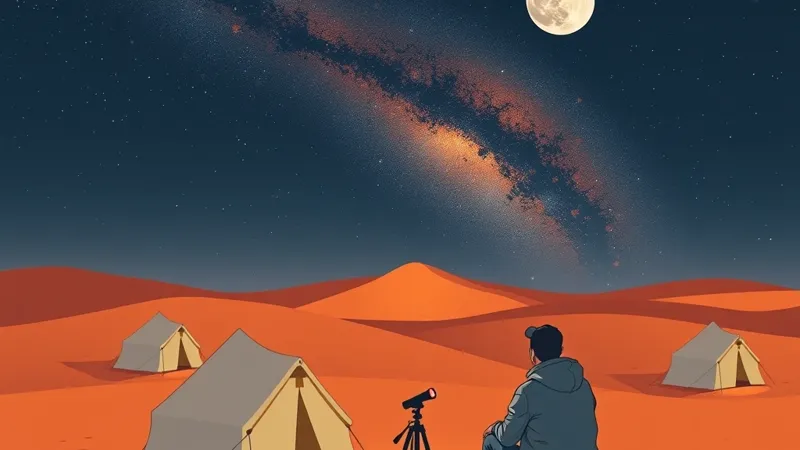
Sahara stargazing in Merzouga is most promising for the bright Galactic Centre from roughly February to October: initially before dawn, through much of the short summer night, and after dusk toward the season’s end. These are seasonal guides, not guaranteed viewing dates. Clear skies, astronomical darkness, a low or absent Moon and limited camp lighting matter more than the words “desert camp.”
Spring and autumn can balance viewing opportunities with less extreme heat, but camp lighting and evening schedules vary. The bright core is only one part of the Milky Way: sections of its wider band can be visible outside core season. Choose your date and observing window first, then ask whether the actual camp can accommodate quiet viewing in darkness.
Which months and hours are best for seeing the Galactic Centre?
The most useful window shifts from pre-dawn in early spring to evening in late summer and autumn. There is no universal nightly timetable: the date, horizon, twilight and Moon all change the opportunity.
- February–April: look for pre-dawn opportunities, initially brief and low in the southeast. The window generally improves as spring progresses.
- May–July: late-night viewing is useful, with the core observable through much of the short night around early summer when other conditions cooperate.
- August–September: evening opportunities become more convenient, although the core moves toward the southwest as the night advances.
- October: the post-dusk window shortens as the core sets earlier. An obstructed horizon or lingering twilight can substantially reduce it.
- November–January: the bright core is poorly placed for dark-night viewing because it lies close to the Sun’s direction in the sky during much of this period. Other sections of the Milky Way remain possible targets.
At Merzouga’s approximate latitude of 31° N, the Galactic Centre stays relatively low in the southern sky. A high dune, tent roof or bright neighboring camp can therefore interfere even when the sky overhead looks clear.
Astronomical darkness means the Sun is at least 18° below the horizon, as explained in the National Weather Service’s twilight definitions. Sunset alone does not mark the start of the darkest viewing conditions.
Use Stellarium with the exact camp coordinates, observing date and Morocco’s applicable local time zone. These seasonal descriptions assume the Merzouga area, not a particular camp or dated sky simulation. Record the coordinates, date, time-zone setting and southern-horizon conditions when making your own plan; do not assume a fixed UTC offset throughout the year.
How do moonlight, clouds and dust affect Sahara stargazing?
A clear, moonless interval usually reveals more Milky Way detail than a bright moonlit night. However, new moon is a useful starting point rather than a requirement: another date can work if the Moon sets before your viewing window or rises afterward.
Moon phase and Moon altitude answer different questions. Phase describes how much of the lunar disk is illuminated; altitude tells you whether it is above the camp’s horizon. Check actual moonrise and moonset alongside the core’s position using the US Naval Observatory’s astronomical data services.
Cloud can hide the sky, while suspended dust can reduce contrast without producing an obvious cloud layer. A clear-sky forecast therefore does not guarantee good transparency. Consult Morocco’s meteorological service for relevant weather information, then ask the provider about local wind and blowing sand closer to departure.
Plan in this order:
- Check that the Galactic Centre is above the local horizon.
- Find the overlap with astronomical darkness.
- Check the Moon’s altitude during that interval.
- Review cloud, wind and dust conditions.
- Confirm camp lights and nearby sources of glare.
- Keep a second viewing window when the itinerary permits.
That backup might be later the same night, before dawn or on another evening. It is an opportunity, not insurance against poor conditions.
What can you see without a telescope, and what should you bring?
You do not need a telescope to see the Milky Way under suitable conditions. To the naked eye, it usually appears as a faint, textured band with brighter patches and dark gaps—not the saturated colors shown in long-exposure photographs.
Visibility depends on eyesight, transparency, moonlight and surrounding lights. Binoculars can enrich the view, but the broad band is best appreciated without magnification. A telescope is useful for selected objects rather than necessary for this experience.
Allow roughly 20–30 minutes for substantial dark adaptation, following the practical approach described in the National Park Service’s stargazing guidance. Avoid bright phone screens and white-light torches; even a red light should be dim and pointed downward.
Bring:
- Closed shoes for sand, uneven ground and the route back to your tent.
- Warm layers appropriate to the forecast, including for long periods sitting still.
- Water and a dim red light.
- An optional tripod or stable phone support.
- Any personal aids needed for comfortable, safe movement after dark.
Smartphone night modes vary considerably. A successful photograph may show more structure than your eyes can see, but neither a phone nor a camera guarantees a useful image. Disable flash, keep screens dim, and ask before photographing other guests or their tents. More general luggage advice is in our Sahara packing guide.
How do Merzouga desert camps handle lighting and nighttime activities?
Camp routines differ, and there is no universal Merzouga desert camp lights-out policy. One evening might involve arrival, dinner, music or conversation, followed by quieter hours; another may retain bright decorative and pathway lighting throughout the night.
Before choosing a camp, ask about:
- Exterior lights: their brightness, direction and operating hours.
- Decorative lighting: whether strings of lights or illuminated tents remain on.
- Pathway safety lights: whether routes stay usable without flooding the viewing area with glare.
- Generator noise: whether a generator is used, where it sits and when it operates.
- Neighboring camps: whether their lights affect the southern horizon.
- Scheduled darkness: whether any lights-out period is explicitly agreed.
- A darker seating area: whether guests may use it and how to reach it safely.
DarkSky International’s responsible-lighting principles favor useful, targeted, low-level, controlled and warm-colored lighting. Apply those principles without asking staff to remove essential safety lighting.
“Luxury” does not establish dark-sky quality. A comfortable camp may have extensive decorative illumination, while a basic camp may still be affected by nearby lights. Budget camps can also involve simpler bedding, facilities or shared arrangements: assess comfort and darkness separately.
Obtain explicit answers from the listed provider. Marketing photographs can be edited or taken away from guest areas; they do not establish what the lighting will be during your stay.
Can you stay outside late or sleep under the stars at a desert camp?
Permission to sit outside after dinner does not automatically include permission to sleep outdoors. Both arrangements depend on the camp, staffing, weather and designated guest areas.
Ask separately:
- Where may guests sit after the evening activities finish?
- Is outdoor sleeping permitted, and in which designated area?
- Is suitable bedding supplied, or must it be arranged separately?
- Can toilets be reached safely throughout the night?
- Is a staff member available overnight, and how can guests contact them?
- What time must everyone be ready for the morning departure?
Use camp-approved viewing spots and agreed routes rather than walking alone into unlit dunes. Wind, blowing sand, falling temperatures, uneven ground and wildlife can change a comfortable plan. If conditions deteriorate, returning indoors should remain straightforward.
Check privacy and quiet hours, particularly if the viewing area borders occupied tents. Families may prefer an early evening window close to toilets and shelter. Guests with mobility needs should ask specifically about firm surfaces, steps, seating and the return route in low light.
Do not assume outdoor bedding, rooftop access or a guided astronomy session is included. A rooftop is not a viewing option unless the provider explicitly confirms safe, permitted access.
How cold or hot is Merzouga at night across the seasons?
Winter nights can feel very cold, while summer nights can remain warm. Your packing decision should follow the actual overnight forecast, expected wind and time spent sitting still—not the daytime temperature alone.
A complete, attributable station-normal dataset is not established here. Consequently, the seasonal summary below is not a table of measured average nighttime lows. It avoids presenting unsourced camp-specific temperatures as climate statistics.
- Winter: January is approximately 6°C / 43°F at night, with colder conditions possible on the dunes. This is a broad destination guide, not an identified station normal or a forecast.
- Spring: nighttime conditions vary; no verified seasonal average low is provided here. Bring an insulating layer and check the dated forecast.
- Summer: nights can stay warm; no verified seasonal average low is provided here. July daytime temperatures often exceed 40°C, and can pass 45°C on the sand. These are daytime conditions, not nighttime averages.
- Autumn: cooler nights make layers useful; no verified seasonal average low is provided here.
Morocco’s meteorological service and the WMO climate catalogue are the appropriate research targets for a defensible climate table. Any station dataset used should identify the station, elevation, distance from Merzouga and averaging period. A nearby station must be labeled as a proxy rather than silently treated as a dune-camp measurement. Those metadata are not available for the broad January figure above.
For practical comfort, consider a warm outer layer in cooler months and bedding appropriate to the forecast. Sitting motionless for an hour feels different from walking back from dinner, especially in wind.
How much travel time should you allow from Marrakech?
Marrakech to Merzouga is roughly 560 km, taking about 9–10 hours by road over the Tizi n’Tichka pass at 2,260 m, before substantial sightseeing stops. Treat those figures as planning estimates and confirm the selected route and itinerary.
A typical three-day, two-night circuit includes only one desert-camp night; the other overnight stop is elsewhere along the route. Long road days, dinner and an early departure can leave less usable stargazing time than the itinerary’s headline suggests.
A longer circuit or two nights near Erg Chebbi can provide another weather window and reduce dependence on one evening. Neither arrangement guarantees clear skies, and two nights “in the desert region” do not necessarily mean two nights in the same camp.
Confirm these logistics individually:
- Road travel: driving time, sightseeing stops and expected arrival near Merzouga.
- Meeting point: the exact pickup location, time and any access restrictions affecting the vehicle.
- Luggage: what stays in the vehicle or storage and what reaches the tent.
- Final camp transfer: whether it is by camel or vehicle, its actual duration and its suitability for your needs.
- Morning transfer: departure timing and how it affects a late night or pre-dawn session.
Camel rides and vehicle transfers are not interchangeable: comfort, luggage capacity and duration differ. Use the actual listing rather than assuming a standard transfer time. Our three-day Marrakech–Merzouga comparison helps explain the itinerary structure.
What should you check before booking a Merzouga stargazing tour?
Book against confirmed camp arrangements and a date-specific sky window, not a promise of “stars in the Sahara.” Weather-dependent visibility cannot be guaranteed.
Send the provider a concise checklist:
- What is the exact camp location, and could the assigned camp change?
- Are dunes, buildings or neighboring lights obstructing the southern horizon?
- Which lights remain on, and is there an agreed darker viewing area?
- Do the arrival, dinner and departure times leave the intended viewing window free?
- What transfers are included, and how long do they take?
- Is astronomy equipment explicitly included, and what equipment is it?
- Is an astronomy guide explicitly included, rather than general evening entertainment?
- Are late outdoor sitting and outdoor sleeping separately permitted?
Only treat a service as included when the listing or written confirmation explicitly says so. A general desert guide is not automatically an astronomy specialist.
Via Sahara is an independent editorial and affiliate comparison guide, not a tour operator; we do not supply guides or run camps. Live prices and ratings belong in the GetYourGuide widgets on individual tour pages, not in undated article figures.
Affiliate disclosure: Via Sahara may earn a commission from bookings made through affiliate links. With your dates, lighting needs and transfer questions ready, compare Sahara tour options and check the relevant provider’s written inclusions before booking.
FAQ: What else should you know about stargazing in Merzouga?
Can you see the Milky Way in winter, and is a full-moon trip worthwhile?
Yes, parts of the wider Milky Way band may be visible in winter, but the bright Galactic Centre is poorly placed during much of November–January. A full-moon trip can still offer moonlit dunes and bright stars, although faint Milky Way detail is reduced. Check whether any useful moonless interval overlaps your target’s visibility.
Can you see it with your eyes, and do camps provide telescopes?
Yes, the Milky Way can be visible to the naked eye under dark, transparent skies. Telescope availability is provider-specific and must be explicitly confirmed; it is not a standard inclusion or a requirement for seeing the band.
Do Merzouga camps turn their lights off?
Some may reduce lighting, but there is no universal policy. Ask about actual operating hours, neighboring camps and a designated darker area. Necessary pathway lights may remain on even during quieter hours.
Can families with children sleep under the stars?
Possibly, but outdoor sleeping requires explicit camp approval and suitable conditions. Confirm bedding, toilets, supervision needs, overnight staff access and a nearby indoor alternative. Sitting outside briefly after dinner is a separate, often simpler request.
Is one night in Merzouga enough for stargazing?
One night can be enough if darkness, weather, moonlight and the itinerary align. Two nights provide another opportunity but no guarantee. For the bright core, choose dates within its broad seasonal window and check the actual observing hours before extending your stay.
Sources
These are research targets and planning resources, not live-verified references. No live consultation dates, camp-coordinate calculations or station-normal verification are claimed for this guide.
- National Weather Service: twilight definitions — background for astronomical darkness.
- US Naval Observatory: astronomical data — date- and location-specific Sun and Moon calculations.
- National Park Service: stargazing guidance — observing preparation and dark adaptation.
- Morocco’s meteorological service — weather information and a research starting point for climate records.
- Stellarium — a sky-planning tool, not a weather forecast or confirmation of camp conditions.
Additional research targets are the European Southern Observatory’s public astronomy resources, the WMO climate catalogue and DarkSky International’s lighting principles. Any subsequent climate comparison should record station identity, elevation, distance, averaging period and actual consultation date. Any dated sky plan should record observing coordinates and time-zone assumptions.
Provider listings and written confirmations support only that provider’s arrangements. Record their dates and recheck anything that could change, especially the assigned camp, transfers, lighting and included equipment.