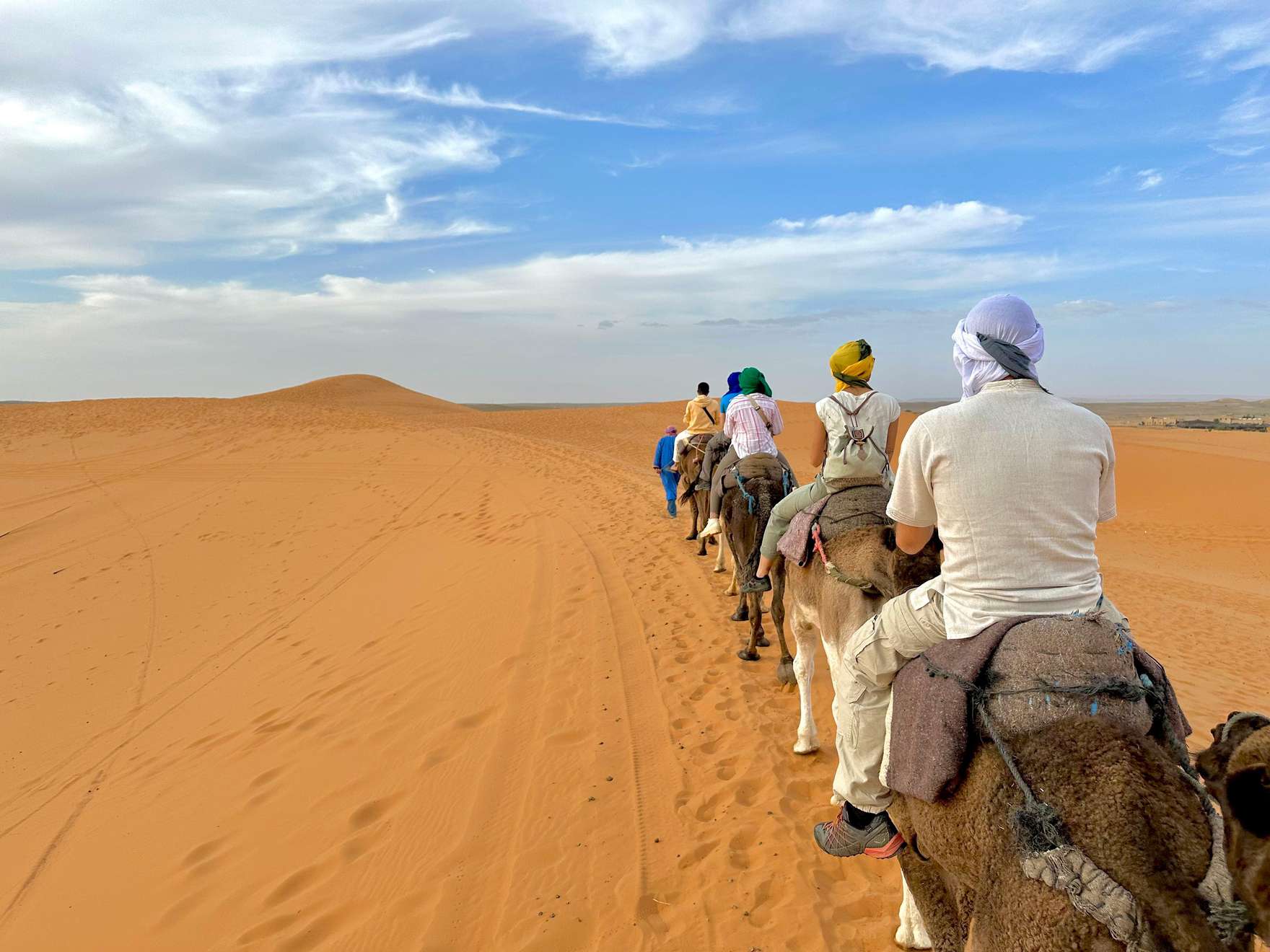
Yes — for most solo female travellers the Marrakech-Merzouga corridor is one of Morocco's most travelled and lowest-crime tourist routes, and thousands of women complete it alone every year, usually on organised or shared tours. The honest nuance is that the main practical challenges are logistical, not violent: a long road journey of roughly 560 km and about 9-10 hours each way, real heat, cold desert nights, and the occasional persistent vendor or unwanted comment rather than serious danger. Morocco sits at Level 2, "exercise increased caution", in US State Department advisories — a rating shared by many mainstream destinations, driven by petty crime and general terrorism vigilance, not by gender-specific violent crime on this route. The UK FCDO similarly describes Morocco as broadly safe for tourists while flagging petty theft and scams in cities.
In short: prepare for a long drive, hot days, and some attention in markets, and the desert itself tends to be the calmest part of the trip. The sections below cover what to expect and how to travel comfortably and confidently on your own.
How safe is Morocco overall for women travelling alone?
Morocco is generally considered safe for solo women, and the official advisories reflect a country where the realistic risks are petty crime and harassment rather than violent crime. Both the UK FCDO and the US State Department keep Morocco open for normal tourism, advising standard caution: watch your belongings in crowds, be alert to scams, and stay aware in busy public spaces.
The most common experiences solo women report are verbal — persistent vendors, unsolicited "guides", catcalls, and repeated questions — rather than assault. These incidents cluster in the dense city medinas of Marrakech and Fes, where foot traffic, narrow lanes and hard-selling create friction. On the desert route itself, where you spend most of your time in a vehicle, a group, or a supervised camp, this kind of attention drops off sharply. It helps to separate perceived risk (a place that feels intense and unfamiliar) from actual risk (the low probability of real harm). The corridor to Merzouga scores low on the second even when the medina can feel high on the first.
What is the Marrakech to Merzouga journey actually like?
The journey is a full desert road trip: roughly 560 km and about 9-10 hours by road each way, crossing the High Atlas via the Tizi n'Tichka pass at around 2,260 m before descending toward the dunes. This is the core of the experience and the single biggest thing to plan for.
A typical routing climbs the switchbacks of Tizi n'Tichka, stops at the fortified earthen village of Aït Ben Haddou — a UNESCO World Heritage site — then runs through the Dades and Todra gorges before reaching the Erg Chebbi dunes near Merzouga, which rise to about 150 m. You have three broad ways to do it:
- A 3-day shared group tour. The most common and lowest-cost option. You travel in a minibus or 4x4 with 6-16 other travellers, which for a solo woman means built-in company, a set itinerary, and never being alone at rest stops or the camp. See the 3-day Sahara tour comparison for how these are structured.
- A private driver. More expensive but flexible: you set the pace, choose stops, and travel with a single, ideally vetted driver-guide. Good for comfort and control; read private vs shared to weigh it against a group.
- Self-drive. Full independence, but you take on 18-20 hours of round-trip mountain and desert driving, navigation, and roadside situations alone — the least common choice for solo first-timers.
For context on the road itself, our how to get to the Sahara from Marrakech guide breaks the route down segment by segment.
Is a group tour or a private tour safer for a solo woman?
Both can be safe; they simply trade different things. A shared group tour gives you constant company and the lowest price, which many solo women prefer precisely because you are never isolated — there are always other travellers around at stops, meals and the overnight camp. A private tour gives you flexibility and a single driver you can vet in advance, plus the comfort of your own schedule, at a higher cost.
Whatever you choose, the practical safety steps are the same:
- Confirm the operator is licensed and running properly insured vehicles.
- Read recent reviews and pay attention to what solo travellers specifically say about the driver and camp.
- Check the live ratings on the tour page before you book.
One honesty note: the prices and star ratings you see on our tour pages come from live GetYourGuide widgets, not fixed figures written into this article, so they update over time — always read the current numbers on the page itself. If you are still deciding, the private vs shared comparison lays out the trade-offs for a solo traveller.
How do I handle unwanted attention or harassment on the route?
Most unwanted attention is verbal and ends quickly once you signal you are not a customer and not interested. A calm, firm approach works far better than either anger or over-politeness.
Practical scripts and habits:
- Say "la, shukran" (no, thank you) clearly, keep walking, and do not soften it into a negotiation.
- Avoid prolonged eye contact with vendors and touts — sustained eye contact reads as interest.
- Keep conversations neutral about travelling alone. "I'm meeting friends," or simply steering the topic elsewhere, is a normal, sensible boundary.
- Use your group or driver as a buffer — stand near them in markets and at stops, and flag anyone persistent to your guide.
On dress: modest clothing that covers the shoulders and knees is worth packing, not as a matter of blame but as everyday comfort and respect for local norms, especially in villages and at the camp. Lighter, looser layers also protect you from sun and dust. This is about blending in and feeling at ease, and it tends to reduce attention rather than invite it.
Is spending the night in a desert camp safe?
A night in a Berber camp at Erg Chebbi is a standard, supervised part of nearly every tour and is generally very safe. Groups arrive together at sunset, camps are run by established operators, and staff are present through the night — you are not alone in the dunes.
What to expect: you typically reach the camp by a camel trek of about 1 to 1.5 hours across the sand at sunset (a 4x4 transfer is usually available if you prefer). Tents range from shared to private, and quality varies a lot by price tier — budget tours can be genuinely basic. Temperatures swing hard: even when summer days pass 40°C, the night on open sand can turn cold, so a layer for the evening matters year-round. In January, expect roughly 19°C by day and around 6°C at night, colder still on the dunes.
When choosing, look for a camp with recent reviews and private toilet facilities if that matters to your comfort — it is one of the clearest dividers between basic and mid-range options. The Sahara tour with a private tent is worth a look if you want more privacy overnight.
What are the real health and weather risks in the desert?
The genuine hazards in the Sahara are environmental — heat, dehydration, sun and cold nights — and they deserve more of your attention than crime. Summer daytime highs around Merzouga regularly hit 40-45°C, and the sand radiates even more, which makes heat exhaustion and dehydration the most likely problems you will actually face.
Sensible, evidence-based precautions, in line with World Health Organization heat-health guidance:
- Drink steadily through the day, well before you feel thirsty, and carry more water than you think you need.
- Protect against sun with high-SPF sunscreen, a wide-brimmed hat or scarf, sunglasses, and covered skin.
- Time activity for cooler hours — treks are scheduled for sunrise and sunset for good reason; avoid strenuous walking at midday.
- Consider avoiding July and August if heat tolerance is a concern; spring and autumn are far more forgiving. Our best time to visit guide has the seasonal detail.
Pack a layer for the night in every season — the same clear desert sky that bakes the day lets the heat escape fast after dark.
How do I stay connected and reach help in the desert?
Mobile coverage is generally reliable in Merzouga village and along the main route, but it becomes patchy once you are deep in the dunes — plan for stretches with no signal. A local SIM or eSIM from a Moroccan carrier gives you the best coverage for the money.
Keep these basics in place:
- Moroccan emergency numbers: police 19 and ambulance 15.
- Share your itinerary with someone at home, including which operator you are with and where you sleep each night.
- Save key details offline — the operator's phone number, your camp or hotel name, and a downloaded map — so a dead signal does not leave you stuck.
- Carry a power bank; charging points at desert camps are limited or unavailable.
What should a solo female traveller pack for the Marrakech-Merzouga trip?
The smart packing list for this route is built around heat, cold nights, and limited services once you leave Marrakech. Each item earns its place:
- Modest, layered clothing — covers shoulders and knees for comfort in villages, and layers handle the day-to-night temperature swing.
- A large scarf — sun cover, dust protection, and a warm layer at the camp, all in one.
- High-SPF sunscreen and sunglasses — sun exposure is intense and reflects off the sand.
- A refillable water bottle — you will drink a lot; refill wherever you safely can.
- A headlamp or small torch — desert camps have little or no lighting at night.
- A power bank — charging is scarce beyond your hotel.
- Basic medications — rehydration salts, painkillers, plasters, and any personal prescriptions; pharmacies are sparse past the main towns.
- Modest cash in dirhams — for tips and small purchases; ATMs are limited beyond Marrakech, so carry enough small notes.
For a fuller breakdown, see what to pack for a Sahara desert tour.
If a supervised, sociable trip with company built in sounds like the right fit, compare the structured options on the 3-day Sahara tour from Marrakech to Merzouga page and read the current reviews before you decide.
Frequently asked questions
Can I do the Marrakech-Merzouga desert tour alone?
Yes. Solo travellers join shared group tours or book a private driver every day of the year on this route. A shared 3-day tour is the most popular choice for women travelling alone because you gain instant company and a supervised itinerary at the lowest cost.
Is it safe to ride a camel as a solo woman?
Yes. The sunset camel trek into the Erg Chebbi camp lasts about 1 to 1.5 hours and is led by camp staff, with the whole group riding together. Wear long trousers and hold the saddle handle; the pace is slow and the camels are used to first-time riders.
How long is the drive from Marrakech to Merzouga?
Roughly 560 km and about 9-10 hours each way by road, crossing the Tizi n'Tichka pass at around 2,260 m. Most tours break the journey with stops at Aït Ben Haddou and the gorges, which is why the desert trip is usually sold as a 3-day round trip.
What is the best time of year for a solo woman to visit?
Spring (roughly March-May) and autumn (roughly September-November) offer the most comfortable temperatures. Summer days often exceed 40°C and can pass 45°C on the sand, while January is mild by day (around 19°C) but cold at night (around 6°C). See our best time to visit guide for details.
Is tipping expected on desert tours?
Tipping is customary and appreciated in Morocco, for your driver-guide and the camp staff in particular. Carry modest amounts of small-denomination dirham notes, since ATMs are scarce once you leave Marrakech and cash is the norm for tips.
Should I book in advance or in Marrakech?
Booking in advance secures a licensed operator and lets you read recent reviews and live ratings before you commit, which is the safer route for a solo traveller. Booking on the ground in Marrakech can be cheaper but gives you less certainty about the operator and camp quality.
Sources
- UK Foreign, Commonwealth & Development Office — Morocco travel advice
- US Department of State — Morocco travel advisory
- Moroccan National Tourism Office (ONMT) — visitmorocco.com
- UNESCO World Heritage — Aït Ben Haddou
- World Health Organization — Climate change, heat and health
Live tour prices and ratings shown on the tour pages are drawn from GetYourGuide widgets and update over time — they are not fixed figures in this article. Always read the current numbers on the page before booking.