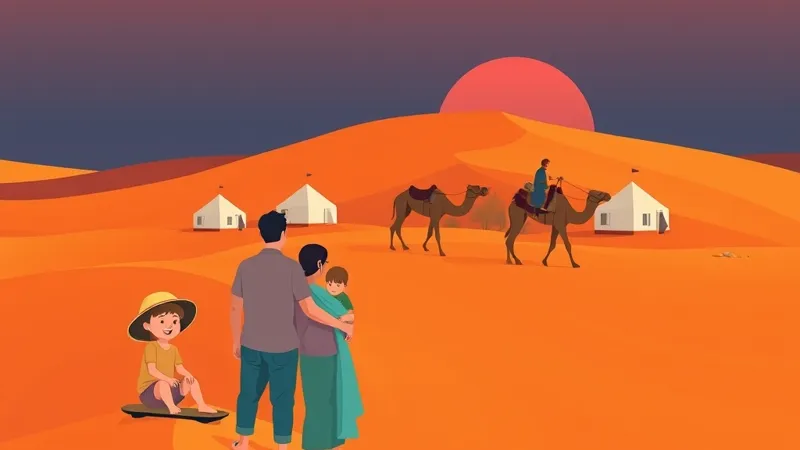
Is a Sahara desert tour from Marrakech suitable for children?
Yes — for most children from roughly age six upwards, the standard 3-day/2-night Merzouga route works well. The reservation is for under-4s: the trip covers about 560 km each way and 9-10 hours of pure driving, split across two days, and that is the part small children struggle with, not the desert itself.
Three variables decide it: your child's age, their tolerance for long car journeys, and the season you travel in. From there the fork is simple:
- Merzouga — 3 days, ~560 km each way, the real Erg Chebbi dunes (up to ~150 m).
- Zagora — 2 days, ~360 km each way, small scattered dunes.
- Agafay — half-day, ~30 km from Marrakech, stony desert, no dunes at all.
Verdict by age band: under 3 — skip Merzouga, choose Agafay. 3-5 — only with a private vehicle and a flexible schedule. 6-9 — the sweet spot; sandboarding, camp nights and a short camel ride all land well. 10+ — the full itinerary, including activities operators restrict by age.
What is the realistic minimum age for a Merzouga desert tour?
There is usually no hard legal minimum age for the vehicle tour itself. Operators do, however, set age limits on individual activities — camel riding, quad biking, buggy tours — and those limits vary by supplier, so check the specific activity page before you assume a child can join.
- Under 3. The drive dominates everything. Two days in a vehicle for one night in a tent is a poor trade. Choose Agafay.
- 3-5. Feasible, but realistically only with a private vehicle, a flexible stop schedule and low expectations about how much of the itinerary you actually complete.
- 6-9. The best fit. Children this age remember the dunes, enjoy sandboarding, sleep reasonably well in a tent and can manage a 60-90 minute camel transfer seated with a parent or on their own animal.
- 10+. The full route, including longer treks and motorised activities where operators allow them.
The honest rule: a child's tolerance for 4-5 hour driving blocks matters more than their birthday. A calm seven-year-old who reads in the car will do better than a restless ten-year-old who does not.
How long is the drive from Marrakech to Merzouga with children?
Roughly 560 km one way, 9-10 hours of pure driving, and it is normally split like this:
- Day 1: Marrakech → Ouarzazate, about 4-4.5 hours, crossing the Tizi n'Tichka pass at 2,260 m.
- Day 2: Ouarzazate → Dades → Todra → Merzouga, a longer but flatter run of switchback-free valley road.
Standard operator rhythm is a stop every two to three hours. With children, plan for a break every 90-120 minutes — legs out, air, water, toilet if one exists. On a shared minivan you cannot impose that rhythm; the group and the schedule decide. On a private tour you can, which is the single strongest argument for paying more when travelling with young kids. We compare the two formats in detail in our guide to private vs shared Sahara tours.
For road-condition context before you travel, check the UK FCDO Morocco travel advice and the Moroccan Ministère de l'Équipement et de l'Eau, which publishes national road network information.
What does the standard 3-day Merzouga itinerary look like from a child's point of view?
Here is the classic route, marked for how well each stop holds a child's attention.
Day 1
- Tizi n'Tichka pass (2,260 m) — 3-4 hours of near-continuous switchbacks with brief photo halts. This is pinch point one and the most likely place for car sickness.
- Aït Ben Haddou — a genuine 60-90 minute walk-around. The ksar has been on the UNESCO World Heritage List since 1987, and children respond to it as a climbable fortified village rather than as heritage. High engagement.
- Ouarzazate film studios — optional, usually 45-60 minutes. Works for teenagers who recognise the films; under-8s generally do not.
Day 2
- Dades Valley — mostly a 20-minute photo halt at the switchbacks. Low engagement, quick.
- Todra Gorge — walls up to about 160 m with the narrowest point around 10 m. A flat, easy 45-60 minute walk between vertical rock. Consistently the biggest hit with kids after the dunes.
- Erfoud → Rissani → Merzouga — pinch point two, several more hours of driving with little to look at.
- Camel transfer into Erg Chebbi at sunset, then the camp.
Day 3 is sunrise on the dunes and the long return drive — or, if you have the days, continue north-east instead of doubling back.
Is the 2-day Zagora tour a better option for younger children?
Zagora is about 360 km and roughly 7 hours each way, with one overnight instead of two. That is genuinely less driving. But the dunes at Tinfou and around Zagora are small and scattered — nothing like Erg Chebbi, which runs roughly 28 km long, 5-7 km wide, with ridges up to about 150 m.
The trade-off in one sentence: Zagora saves a day of driving, but the child sees a much smaller desert.
Whether that matters depends on why you are going. If the point is a camel, a tent and a night under stars, Zagora delivers all three. If the point is the sand sea children have pictured in their heads, it does not. Our side-by-side breakdown is here: 2-day Zagora vs 3-day Merzouga.
Erg Chegaga, near M'hamid, is the middle option — larger dunes than Zagora, fewer visitors than Merzouga — but it sits further south and requires a 4x4 transfer over rough piste to reach the camp. That last leg is exactly the kind of bumpy, unpredictable hour that goes badly with young children, which is why it rarely suits families.
When is the Agafay desert the better choice than the Sahara?
Agafay is about 30 km from Marrakech, 40-60 minutes by road, and it is the right answer more often than families expect. It offers camel rides, tented camps, dinner outdoors and — at many sites — a pool, with no long-haul driving at either end.
Be clear about what it is not. Agafay is not the Sahara. It is hamada: stony, compacted desert with rolling grey-brown hills and no sand dunes. Marketing photography frequently blurs this, using tight crops and golden-hour light that imply dunes which are not there.
The rule: if you have fewer than three free days, choose Agafay rather than compressing Merzouga into a rushed two-day run. A two-day Merzouga attempt means roughly 18-20 hours in a vehicle for a few hours of dunes — the version of this trip families most often regret. Agafay is also the default for children under about five.
At what age can a child ride a camel in Erg Chebbi?
The standard camel transfer covers roughly 4-5 km from the edge of the erg to the camp and takes about 60-90 minutes, normally at sunset.
- Most operators seat children under 6 in front of a parent rather than on their own dromedary.
- Many decline children under 3-4 entirely.
- The scariest moment is not the walking — it is mounting and dismounting, when the camel rises and folds back down in two sharp lurches. Warn children in advance.
- Saddle frames are hard, there is no back support, and even a late-afternoon departure means real sun exposure.
The alternative is straightforward and no one should feel awkward asking for it: most tours offer a 4x4 transfer to the camp. For a nervous, very young or overtired child, that is the better call, and it takes about fifteen minutes instead of ninety.
On welfare: check that animals look well-fed, that saddles sit on padding, and that a shaded rest area exists. The ABTA Animal Welfare Guidelines set out the industry standards used by many tour operators, and World Animal Protection publishes guidance on riding and working animals in tourism.
What should families check about a desert camp before booking?
A checklist worth screenshotting before you book:
- Private or shared tent? Budget camps often mean thin partitions and shared sleeping areas.
- En-suite bathroom and hot water? This is the sharpest difference between standard and luxury camps. Standard camps frequently have shared blocks and limited hot water.
- Electricity hours — generator or solar, and whether there is a power point for a nightlight. Many camps cut power around midnight.
- Distance to the nearest medical facility, typically Rissani or Erfoud, both a drive away over sand and piste.
- Meal flexibility — can the kitchen do plain rice, bread, pasta for a picky eater?
- Night waking — ask directly how staff handle a child awake at 3 am, and whether someone is on duty.
Two structural points. First, tents are not soundproof; drumming and music often run late, and sound carries across a quiet camp. Second, there is a real difference between camps inside the erg (reached by camel, deeper into the dunes, no vehicle access) and camps on the edge (reached by 4x4, faster to leave in an emergency). Edge camps suit families for exactly that reason. If a private tent with its own bathroom is the deciding factor, that is a specific product category — see Sahara tours with a private tent.
What temperatures should a family expect in Merzouga through the year?
- Summer (June-August). Daytime highs in the Errachidia/Merzouga area regularly exceed 40°C and July can pass 45°C on the sand. July and August are genuinely unsuitable for young children.
- Spring (March-May) and autumn (September-November). The recommended family windows: warm days, manageable nights.
- Winter (December-February). Mild days — January runs around 19°C by day and about 6°C at night, colder out on the dunes, where clear-sky nights can approach or drop below 0°C. Camp tents are unheated; blankets are the only insulation.
Verify current figures against the WMO World Weather Information Service climatological normals for Errachidia and Ouarzazate, and the Direction Générale de la Météorologie du Maroc.
How do you prevent heat, sun and stomach problems in children on a desert tour?
General prevention, grounded in health-authority guidance:
- Fluids. Children dehydrate faster than adults and complain later. Offer water at every stop rather than waiting to be asked. Watch for heat exhaustion: headache, unusual tiredness, clammy skin, nausea, dizziness. Move to shade, cool and rehydrate immediately. The WHO guidance on heat and health identifies children as a high-risk group.
- Sun. UV is intense even on a cool spring day at altitude or in open desert. A wide-brim hat plus long, light sleeves beats sunscreen alone — sunscreen rubs off, gets missed on ears and necks, and does nothing about heat load.
- Food and water. Bottled or treated water, no ice of unknown origin, hot cooked food, peelable fruit. See CDC Travelers' Health – Morocco and NHS Fit for Travel – Morocco for current recommendations, including routine vaccination status.
This is general information, not a substitute for a pre-travel consultation with your doctor or a travel clinic — particularly for children with existing conditions.
How do you manage car sickness on the Tizi n'Tichka road?
The Tizi n'Tichka crosses the High Atlas at 2,260 m on a road of near-continuous switchbacks, and car sickness is the single most common reason a family desert tour goes wrong on day one.
- Seat position. Middle row, forward-facing, eyes on the horizon through the windscreen. Avoid the rear bench.
- Meals. A light breakfast at least an hour before departure. Not nothing, not a big one.
- Ventilation. Cool air on the face, window cracked, no strong smells in the cabin.
- Screens. Reading and tablets make it worse on this road. Save downloaded films for the flat sections after Ouarzazate.
- Stop early. Ask the driver to pull over at the first sign of paleness or silence, not after.
- Medication. Discuss any motion-sickness product for children with a pharmacist or doctor before departure, not at a roadside pharmacy.
One clarification: this is not altitude sickness territory. At 2,260 m you are well below the elevation where acute mountain sickness usually appears. The two get confused because the symptoms — nausea, headache, fatigue — overlap and both happen on a mountain pass. On the Tichka, the switchbacks are almost always the cause.
If anyone in the family is a known car-sickness sufferer, request a private vehicle specifically so the driver can stop on demand.
What should you pack for a child on a Sahara tour from Marrakech?
Tied to this route, not a generic list:
- Layers. The day-to-night swing at the camp can exceed 20°C. A fleece and long trousers for the evening even in spring.
- Closed shoes for Todra Gorge and Aït Ben Haddou, plus sandals for sand — dune sand gets into everything.
- A head covering with a brim or a scarf.
- A refillable bottle per child.
- Wet wipes and hand sanitiser — several roadside stops have no running water.
- A power bank. Camp electricity is time-limited and outlets are scarce.
- A small nightlight or head torch. Camps are genuinely dark at night and tents look identical.
- Offline-downloaded entertainment for the two long driving blocks. Do not count on mobile data between Ouarzazate and Erfoud.
On child car seats: they are not standard equipment in Moroccan tour minivans. Ask the operator in writing before booking whether one can be provided and fitted, and consider bringing your own. Our full checklist is in what to pack for a Sahara desert tour.
Which parts of the standard itinerary are worth skipping with kids?
Skip:
- Quad biking and buggy tours. Most operators set minimum ages, and helmets rarely fit small heads properly.
- The Ouarzazate film studio tour for under-8s. They will not recognise a single film, and it is a paid stop.
- Long carpet, argan and fossil workshop stops. These are essentially sales visits, and 45 minutes in a showroom with a bored child helps no one. It is fine to wait outside.
- Any itinerary promising Merzouga in two days. The arithmetic does not work with children.
Swap in:
- Sandboarding on a low dune near the camp — the highest fun-per-minute activity on the whole trip.
- A short nomad family visit, where offered and done respectfully.
- Sunrise from the dune ridge instead of a second long camel ride back.
- An unhurried afternoon at the camp instead of a third gorge stop. Children need one block of unstructured time more than they need one more viewpoint.
Is the desert night sky worth keeping children up for?
Yes — and it is often the part they remember longest. Erg Chebbi has very low light pollution, and on moonless nights the Milky Way is visible to the naked eye for much of the year.
Plan around the lunar cycle:
- New moon — the darkest sky and the most stars, but the dunes are genuinely black underfoot. Bring torches.
- Full moon — washes out the faint stars, but lights the dunes well enough for children to walk the ridge safely after dinner. For younger kids, this is often the better night.
A simple activity that works: give each child three constellations to find, then watch for satellites — slow, steady points of light crossing the sky, easy to spot and unmistakably not aircraft. Background on why the sky here is so dark is available from DarkSky International, and the region's professional astronomy reference is the Oukaïmeden Observatory, run by Cadi Ayyad University in the High Atlas.
How much does a family Sahara tour from Marrakech cost?
Understand the structure rather than chasing a number:
- Shared group tours price per adult, with reduced or free child rates that vary by operator and by the child's age. There is no industry-wide rule — some cut off free travel at 3, others at 5 or 6.
- Private tours price per vehicle. This is why they often become competitive from three or four people, and why a family of four sometimes pays little more for a private car than for four shared seats.
- Camp upgrades — private tent, en-suite bathroom, heating — are the main variable and can change the total substantially.
Typically excluded: lunches, monument entrance fees, and tips for driver and camp staff.
Via Sahara is an editorial guide, not a tour operator, and we do not quote prices in articles. Current prices, availability and each operator's child-rate rules appear in the live booking widgets on the relevant tour pages.
If the age bands above put your family in the six-and-up range and you have three days to spend, the Merzouga route is the one that delivers the dunes children actually picture — compare the operators, camps and departure options on our 3-day Sahara tour from Marrakech to Merzouga comparison, where child rates and current availability are shown live.
Frequently asked questions about Sahara tours from Marrakech with children
What is the youngest age for a Merzouga tour?
Most operators set no legal minimum for the vehicle tour, but practically the trip suits children from about six. Between three and five it works only with a private vehicle and a flexible schedule. Under three, the two long driving days outweigh the one night in the desert — choose Agafay instead.
Can a 4-year-old ride a camel?
Usually only seated in front of a parent, and some operators decline children under three or four entirely. Rules vary by supplier, so check the specific activity page. The 4x4 transfer to the camp is available on most tours and is a reasonable choice for a small or nervous child.
Are there toilets on the drive?
Yes, at scheduled café and restaurant stops, but standards vary and some have no running water or paper. Carry wet wipes, hand sanitiser and tissues. On a shared minivan the stop schedule is fixed; a private vehicle lets you stop when a child needs to, which matters more than it sounds.
Is the desert camp safe for kids at night?
Camps are staffed overnight and the dunes immediately around them are not hazardous, but it is genuinely dark and tents look identical from outside. Bring a head torch and a nightlight, agree a rule that children do not leave the tent alone, and note where the staff tent is before bed.
What if a child gets ill in the desert?
The nearest medical facilities are in Rissani or Erfoud, a drive from the erg over sand and piste. Camps on the edge of the dunes with 4x4 access can reach them faster than camps deep inside. Carry a basic kit, oral rehydration salts, and any regular medication in the vehicle rather than in luggage.
Are car seats provided?
Generally no. Child car seats are not standard equipment in Moroccan tour minivans and cannot be assumed. Ask the operator in writing before booking whether one can be supplied and properly fitted, and consider bringing your own — particularly for a route with roughly nine to ten hours of driving each way.
Can we skip the camel ride?
Yes. Most tours offer a 4x4 transfer to the camp as an alternative, taking around fifteen minutes rather than 60-90. Confirm this at booking rather than on the day. Skipping the ride does not mean missing the dunes — you still arrive at the same camp in the same erg.
Is July too hot?
For young children, yes. Daytime highs around Merzouga regularly exceed 40°C in July and can pass 45°C on the sand, and camps are not air-conditioned. Spring (March-May) and autumn (September-November) are the recommended family windows. Check current normals with the WMO World Weather Information Service before booking.
Do we need vaccinations?
There are usually no compulsory vaccinations for travel to Morocco from most countries, but routine childhood immunisations should be up to date and additional vaccines may be advised. Check NHS Fit for Travel or CDC Travelers' Health for current recommendations, and consult a travel clinic four to six weeks before departure.
Is Zagora enough if we only have two days?
It depends what you want. Zagora gives a camel, a camp and a night under stars with about seven hours of driving each way instead of nine to ten. But its dunes are small and scattered, not the ~150 m ridges of Erg Chebbi. With two days it is the honest choice; with three, Merzouga is a different experience.
How cold does the camp get in winter?
January days run around 19°C, dropping to roughly 6°C overnight and colder out on the open dunes, where clear skies can push temperatures towards or below freezing. Tents are unheated and rely on blankets. Pack thermal layers, hats and warm socks for sleeping, and ask the camp how many blankets are provided.
Can we do the tour with a baby in a carrier?
Physically possible, rarely advisable. The obstacle is not the desert but the driving — roughly nine to ten hours each way, no car seat as standard, and limited changing facilities on the route. For infants and toddlers, Agafay at 30 km from Marrakech gives camels, a camp and dinner outdoors without any of that.
Sources and further reading
Heritage and geography
- UNESCO World Heritage Centre — Ksar of Aït Ben Haddou (inscribed 1987)
- UNESCO Man and the Biosphere Programme — Oasis du Sud Marocain Biosphere Reserve (World Network of Biosphere Reserves)
Climate
- WMO World Weather Information Service — climatological normals for Errachidia and Ouarzazate
- Direction Générale de la Météorologie du Maroc
Health
- CDC Travelers' Health — Morocco
- CDC Yellow Book — Health Information for International Travel
- WHO — Climate change, heat and health
- NHS Fit for Travel — Morocco
Safety and road conditions
- UK Foreign, Commonwealth & Development Office — Morocco travel advice
- US Department of State — Morocco international travel information
- Ministère de l'Équipement et de l'Eau du Maroc — national road network
Tourism authority
Animal welfare
Astronomy
- DarkSky International
- Oukaïmeden Observatory, Université Cadi Ayyad, High Atlas