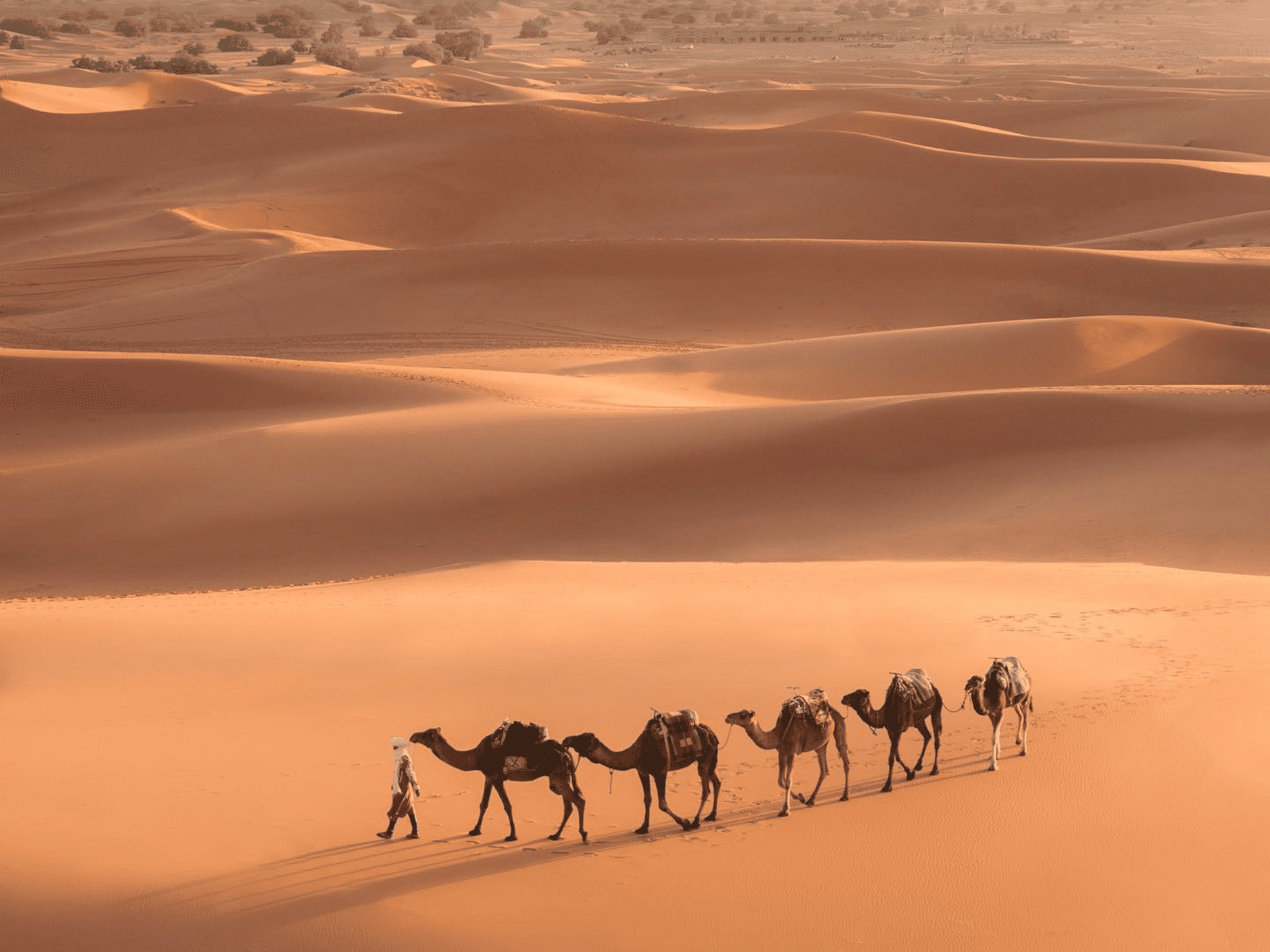
A camel ride in Merzouga is a slow, swaying walk on a one-humped dromedary that a camel guide leads on foot — not a gallop, not a race. You sit on a wooden or padded saddle, hold a front handle, and move in single file with other riders across the Erg Chebbi dunes. The classic sunset or sunrise ride runs about 1 to 1.5 hours each way, usually to reach a desert camp among the dunes. The pace is gentle (a walking human sets it), the height feels tall at first, and the motion rocks you back and forth. If riding isn't for you, that's fine: you can reach almost every Erg Chebbi camp by 4x4, on a quad, or on foot — this guide covers each option honestly, with real durations and no sugar-coating.
Erg Chebbi is the sea of dunes near Merzouga in south-east Morocco, with crests rising up to roughly 150 metres. The camel trek is the postcard image of the Sahara, but it is only one short segment of a longer trip — and it's optional far more often than people assume.
What is a camel ride in Merzouga actually like?
It is a calm, rhythmic walk at roughly 3–5 km/h, with a guide on foot holding the lead rope of the first camel; the rest are tied nose-to-tail behind. You mount while the camel is kneeling, then it stands back-legs-first, so you lurch forward and then back — hold the saddle handle for that moment. Once moving, the dromedary sways side to side and the saddle rocks with each step. You sit high, often 2 metres off the ground, in single file with the other riders.
There is no trotting or galloping on a tourist trek. The whole point is a slow transfer over soft sand that a vehicle can't cross as easily. Most rides head out to catch low sun over the dunes, so you'll ride into fading or rising light with long shadows on the sand. It is quiet — mostly the sound of feet in sand and the creak of the saddle.
How long do you sit on the camel?
The standard camp transfer is roughly 45 to 90 minutes each way, depending on how deep the camp sits inside Erg Chebbi. A short sunrise or sunset loop that returns to the same point can be about one hour round trip. Most camps lie 2–5 km into the dunes, and at a camel's walking pace of 3–5 km/h, that maths out to under an hour and a half in the saddle for the deeper camps.
If you want a shorter time on the animal, ask before booking how far the camp is and how long the ride takes — operators know the number. A camp on the dune edge might be a 20-minute ride; a remote luxury camp can be the full 90 minutes. Budget tours sometimes place camps deeper to sell the "real desert" feeling, which means longer in the saddle.
Is riding a camel in Merzouga comfortable or painful?
Honestly: it's tolerable for most people for the first 45 minutes, and less so after that. The rocking motion puts pressure on your inner thighs and tailbone, and you'll instinctively grip the front handle to stay balanced, which tires your arms and shoulders. Saddles vary — some are bare wood with a blanket, others are padded — and you don't get to choose.
First-timers usually feel fine at the start and start shifting around once the novelty fades. A few practical fixes genuinely help: wear loose long trousers so the saddle doesn't chafe bare skin, sit upright rather than slumping (slouching drives pressure into your tailbone), keep your weight balanced over the hump, and shift your seat every few minutes. If you have a bad back, coccyx or hip issues, this is exactly the point to consider a vehicle instead — see the alternatives below.
What should you wear and bring for a camel trek?
Wear long trousers, closed shoes or sturdy sandals, and bring a scarf, sunglasses and water — the desert swings from hot to cold fast. Long trousers are the single most useful item: they stop the saddle from rubbing your legs raw. A cheche (the long cotton head-scarf locals wear) shields your face from sun and blowing sand and doubles as neck cover.
Also pack:
- Layers. Daytime sun can be strong while nights turn cold, so a fleece or jacket earns its space.
- Sunglasses and sunscreen for glare off pale sand.
- A small bag you can wear, not carry — you'll want both hands for the saddle.
- Water, since even short rides leave you dry.
For a full checklist by season, see our Sahara packing guide. The Moroccan National Tourist Office also publishes general desert-travel advice worth a scan before you go.
How hot does it get, and when is the best time to ride?
Summer is brutal and winter nights are cold, which is exactly why rides are scheduled at sunrise and sunset. In July, daytime temperatures around Erg Chebbi often exceed 40°C and can pass 45°C on the open sand. In January, expect roughly 19°C by day but around 6°C at night — colder still up on the dunes, where a clear sky pulls heat away fast. This wide day-to-night swing is normal for the Sahara.
The camel treks run in the early morning and late afternoon for two reasons: the light is gentler for photos, and the sand and air are cool enough to be bearable. Riding at midday in summer is neither safe nor pleasant for you or the camel.
The most comfortable months are the shoulder seasons — spring (March–May) and autumn (September–November) — when days are warm rather than scorching and nights aren't freezing. For a month-by-month breakdown, read when to visit the Sahara.
Is riding a camel in Merzouga ethical?
It can be, but it depends entirely on how the animals are kept — so it's worth knowing what to look for rather than taking a blanket yes or no. A well-kept dromedary is in good body condition (not visibly bony), has no raw sores or wounds where the saddle and girth sit, moves without limping, and gets rest between treks rather than working non-stop. The normal, humane practice on a tourist trek is to lead camels on foot at walking pace with a light load — one rider per camel, plus a modest gear weight.
If a camel looks thin, has open saddle sores, or is being made to carry too much or move too fast, that's a reason to decline and say why. Rather than trusting any single operator's marketing, lean on recognised welfare guidance: SPANA, a working-animal charity that operates clinics in Morocco, and World Animal Protection both publish practical advice on assessing animals used in tourism. The FAO has technical material on dromedary husbandry if you want the deeper background. Choosing the vehicle option is also a perfectly legitimate ethical choice — no one should feel pressured onto a camel.
What are the alternatives if you would rather not ride a camel?
You have several, and none of them make your trip lesser. Here are the main ones, with honest trade-offs:
- 4x4 transfer to the camp — the fastest and most comfortable, usually 15–20 minutes over graded sand tracks. Good for back problems, mobility issues, young kids or anyone short on patience. You miss the slow-approach ritual but arrive fresh.
- Quad / ATV over the dunes — active and quick, and you control the pace. It costs extra, isn't quiet, and isn't for everyone environmentally, but it's genuinely fun on the sand.
- Sandboarding — hire or borrow a board and slide down a dune face. Low cost, high effort climbing back up, and best combined with another transfer.
- Guided walking to a nearby dune — free or cheap, and it lets you feel the scale of Erg Chebbi at your own speed. Sand walking is tiring, so keep distances short.
- A dune-edge camp reachable by vehicle — some camps sit close enough to the sand's edge that you drive right up and walk a few metres.
Cost roughly tracks effort and speed: walking and a shared 4x4 are cheapest, quads sit at the top. See how activities bundle into different itineraries on our compare page.
Can you reach a desert camp without a camel at all?
Yes. Most Erg Chebbi camps — from basic to luxury — offer 4x4 or walking access, and you can request a vehicle transfer instead of the camel leg. Travellers with back problems, reduced mobility, a fear of animals, or those who are pregnant regularly do exactly this, and good operators are used to arranging it.
The key is to ask before you book. When you enquire, say plainly: "I'd like to swap the camel ride for a 4x4 transfer to the camp — is that possible, and does it change the price?" Reputable operators will confirm in writing. Because the camel segment is short and optional on many trips, swapping it rarely changes the overall day much. If a company insists the camel is mandatory, that's a signal to compare other options.
How does the camel ride fit into a Marrakech-to-Merzouga tour?
It's one short segment near the end of a long road trip. Merzouga sits roughly 560 km from Marrakech — about 9–10 hours of driving over the Tizi n'Tichka pass (2,260 m) — so it's almost always sold as a 3-day / 2-night tour, with an overnight in the Dades or Todgha area and the desert camp on night two. The camel ride is the brief bit that carries you from the trailhead to that camp, typically under 90 minutes.
On many itineraries the ride is optional, and you can request a vehicle transfer instead (see above). Because it's such a small slice of the schedule, choosing not to ride doesn't unravel the trip. Route options that pass Aït Ben Haddou — a UNESCO World Heritage site — are common on the way. For the full journey breakdown, see how to get to the Sahara from Marrakech. Live prices and current ratings for each tour appear only in the booking widgets on our linked tour pages — we don't quote them in articles, because they change.
Ready to plan the trip around the ride?
If you now know whether you want to ride or skip it, the next step is matching that to an itinerary. Compare the classic route — camps, camel-or-4x4 options and what's included — on our 3-day Sahara tour from Marrakech to Merzouga page, where you can check live details before deciding.
Frequently asked questions
Is a camel ride included in Merzouga tours?
Usually yes — most 3-day Merzouga itineraries include a sunset or sunrise camel ride to the desert camp as standard. It's typically already in the price, not an add-on. On many tours it's also optional: you can ask to swap it for a 4x4 transfer, sometimes at no extra cost. Confirm both the inclusion and any swap when you book.
Can children ride a camel in Merzouga?
Often yes, but it depends on age and the operator's rules. Small children usually ride with a parent or in a saddle seat, while older kids can ride solo under supervision. The guide leads on foot at walking pace, which keeps it slow. For very young or nervous children, a short 4x4 transfer to the camp is calmer and simpler — ask in advance.
Is a camel ride safe for beginners?
Yes, for most people. The camel is led on foot at a slow walk, you sit on a saddle with a front handle to hold, and there's no trotting or galloping on tourist treks. The main risk is losing balance when the camel stands or kneels, so grip the handle then. Tell your guide about any medical concern before mounting.
What if I'm afraid of animals or have back pain?
Request a vehicle transfer. Almost every Erg Chebbi camp is reachable by 4x4 or on foot, and swapping the camel leg is a normal, common request — good operators arrange it without fuss. Ask before booking and get it confirmed. A 15–20 minute 4x4 ride replaces up to 90 minutes on a swaying saddle, which is far kinder to a bad back.
How many people ride per camel, and can I get off midway?
One rider per camel is the norm, with a light gear load, which is also better for the animal's welfare. Camels travel single file, tied nose-to-tail, led by a guide on foot. You generally stay seated until the guide halts the caravan and helps the camel kneel — you can't easily dismount mid-dune alone, so tell your guide early if you need to stop.
Sources
- Moroccan National Tourist Office (visitmorocco.com) — official destination and desert-travel information for Morocco.
- UNESCO World Heritage Centre — Aït Ben Haddou — heritage context for the Marrakech–Merzouga route.
- FAO (Food and Agriculture Organization) — technical material on dromedary husbandry and welfare.
- SPANA — working-animal welfare charity with clinics operating in Morocco.
- World Animal Protection — guidance on assessing animals used in tourism.