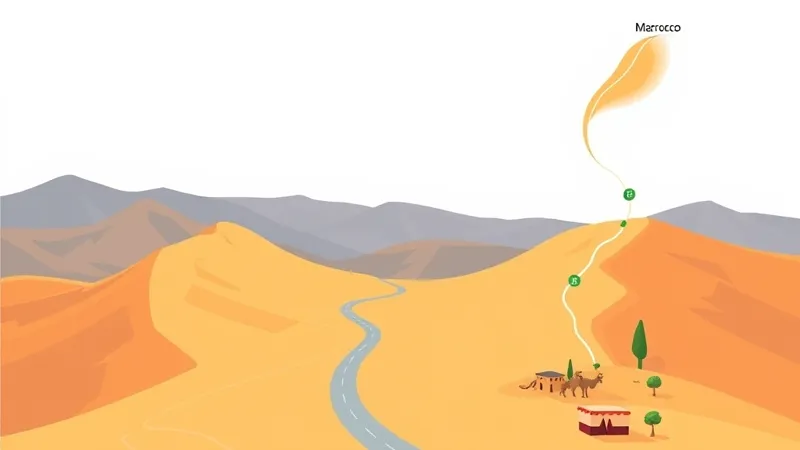
Fes generally offers the shorter road journey to Merzouga: roughly 7–9 hours of driving. Marrakech is roughly 560 km away, about 9–10 hours by road, but suits travelers who want the High Atlas, Ait Ben Haddou and southern valleys along the way. These are planning estimates, not door-to-camp timings.
The best starting point depends on your whole Morocco itinerary. Returning to your departure city means retracing substantial ground; finishing in the other city can turn the desert journey into an onward travel route. Neither city is universally better.
Via Sahara is an independent editorial and affiliate comparison guide, not a tour operator. We do not run departures or employ tour guides.
Is Fes or Marrakech the better starting point?
Choose Fes for a shorter approach when you are already in northern Morocco. Choose Marrakech when the southern scenic corridor is part of what you want to see, rather than simply a road to the dunes.
Here is the compact comparison:
- Fes: about 7–9 driving hours each way; two days is possible but rushed for a return trip. The corridor includes Ifrane, the Middle Atlas, Midelt and the Ziz Valley. Finish in Fes or continue toward Marrakech.
- Marrakech: allow roughly 9–11 driving hours depending on the route and pickup; the usual reference is roughly 560 km and 9–10 hours. Three days is a common format. Stops can include Ait Ben Haddou, Ouarzazate and the Dades or Todra areas. Return to Marrakech or continue to Fes.
Those durations describe practical formats, not equal amounts of desert time. Check the overnight locations before comparing packages.
How far is Merzouga from Fes and Marrakech, and how long is the drive?
Fes is generally closer, but both approaches require a substantial road journey. Driving time is not total elapsed travel time: meals, sightseeing, group pickups and the final camp transfer all add time.
For Fes, use roughly 7–9 hours behind the wheel as an editorial planning range. For Marrakech, use roughly 9–11 hours, with roughly 560 km and about 9–10 hours as the central reference. Exact pickup points, accommodation locations and route choices matter.
Marrakech departures commonly split the outward journey with a hotel overnight. A Fes itinerary may reach Merzouga in one long day, but stopping for lunch and sightseeing can make arrival considerably later than the driving estimate suggests.
Also distinguish three destinations:
- Merzouga village: the settlement used as a road destination and meeting point.
- Erg Chebbi accommodation: hotels and camps around the dune area, with different access arrangements.
- Your final camp: potentially reached through a separate camel or vehicle transfer from a meeting point.
A road estimate to Merzouga does not establish when you will reach your tent. Ask where the road vehicle stops, how luggage continues and how long the last transfer takes.
These figures are not official measurements or live-verified road conditions. Check the specific route and consult Morocco’s Ministry of Equipment and Water for relevant road notices, particularly before mountain travel.
How many days should you allow for each route?
Two days from Fes is possible but road-heavy; three days from Marrakech is common but still involves substantial driving. Four or more days can provide a slower pace, depending on where the extra night is placed.
The following overnight patterns are illustrative, not guaranteed schedules:
- Fes–Merzouga–Fes, two days: one camp night; very high driving intensity on both days; usually only an arrival evening and departure morning near Erg Chebbi.
- Fes–Merzouga–Fes, three days: potentially two nights near the dunes; long travel days at either end; a full intervening day near Erg Chebbi if the itinerary explicitly provides it.
- Marrakech–Merzouga–Marrakech, three days: commonly one hotel night en route and one camp night; substantial driving, especially on the return; usually an evening and morning near the dunes.
- Marrakech–Merzouga–Fes, three days: commonly one southern-valley hotel night and one camp night; substantial road time throughout; limited dune time despite changing cities.
- Fes–Merzouga–Marrakech, three days: a possible pattern is one camp night followed by a southern-valley hotel night; long driving sections; the precise allocation varies by supplier.
- Either departure, four or more days: hotel and camp nights vary; potentially less rushed sightseeing or more time near Erg Chebbi, but only if the additional day is allocated accordingly.
Tour length does not equal time in the dunes. An extra night in Ouarzazate is useful for breaking up travel, but it is not another desert night. Our three-day Marrakech to Merzouga comparison helps frame that distinction.
What can you see on the routes from Fes and Marrakech?
The Fes corridor emphasizes the Middle Atlas and Ziz Valley, while the Marrakech corridor combines a High Atlas crossing with southern towns, historic architecture and valleys. Treat places shown on a route map separately from stops actually included in the schedule.
From Fes, the usual corridor passes through or near Ifrane, the Middle Atlas, Midelt and the Ziz Valley. Cedar-forest stops, walks and particular viewpoints depend on the itinerary; their proximity does not guarantee a visit.
From Marrakech, the road crosses the High Atlas over the Tizi n’Tichka pass, at approximately 2,260 m. That is the pass elevation, not Merzouga’s elevation. Its practical relevance is the winding mountain approach and possible weather-related delays.
Ait Ben Haddou is a frequent sightseeing stop, followed by travel through the Ouarzazate area and onward toward the southern valleys. UNESCO’s Ksar of Ait-Ben-Haddou listing provides the cultural context for its earthen architecture. A guided visit, admission-related expenses and time on foot should be checked separately.
Dades and Todra are not interchangeable guaranteed stops. A hotel described as being in the Dades area does not necessarily include a long gorge excursion; a Todra stop might be brief. The Moroccan National Tourist Office is a useful source for destination context, not proof of a particular tour’s stopping pattern.
Should you return to the same city or finish in the other city?
A one-way route makes sense when both Fes and Marrakech are already in your Morocco itinerary. It can reduce backtracking across the wider trip, but it does not remove the long journeys on either side of Merzouga.
Compare the alternatives against these practical details:
- Arrival and departure airports: does the route move you toward your eventual flight, or away from it?
- Remaining itinerary: a return trip may fit a Marrakech-based stay; a one-way trip may fit onward exploration of northern Morocco.
- Luggage: confirm suitcase allowances, what stays in the main vehicle and what can go to camp.
- Final drop-off: ask whether it is at your accommodation, a vehicle-accessible meeting point or another designated location.
- Check-in: tell your next accommodation that arrival may be late and confirm access arrangements.
A Marrakech–Merzouga–Fes route and a Fes–Merzouga–Marrakech route cover similar broad regions in reverse, but their daily timing and overnight stops need not mirror each other. Our Marrakech to Fes desert-tour comparison focuses on the northbound option.
Allow an overnight buffer before an important flight rather than relying on an advertised tour arrival time. Road conditions, stops and transfers can change that timing.
How should you compare tour prices and inclusions?
Compare the full itinerary and accommodation specification, not departure city alone. The shorter Fes approach is not automatically cheaper: dates, occupancy, transport arrangements and inclusions all affect the comparison.
Use the same checklist for each candidate:
- Transport: shared or private vehicle, stated group size, seating arrangements and daily driving plan.
- Hotel nights: actual location, room occupancy and whether the hotel is named or subject to substitution.
- Camp setting: location relative to the dunes, vehicle access and whether the photographs represent the accommodation category being sold.
- Bathrooms: private or shared facilities, toilet location and stated shower arrangements.
- Meals: exactly which breakfasts and dinners are included, plus lunch and drinking-water costs.
- Guiding: whether the service includes a driver, a guide, local sightseeing guides or some combination.
- Transfers: camel ride, vehicle alternative, luggage handling and any additional charges.
- End point: return to the same city or onward drop-off elsewhere.
Budget camps may have basic facilities. A private tent does not, by itself, establish a private bathroom, heating, cooling or step-free access.
Current prices, availability and ratings are presented through GetYourGuide widgets on Via Sahara’s tour pages. Compare the same travel dates, party size and occupancy; this article does not quote live commercial figures.
Affiliate disclosure: Via Sahara may earn a commission from qualifying bookings through affiliate links or widgets. We provide editorial comparisons, not the tour itself. Read both the marketplace booking conditions and the selected supplier’s itinerary, inclusions and cancellation terms; a general marketplace statement is not a substitute for the conditions attached to your booking.
How do season and weather affect your choice?
Both starting points lead to the same Erg Chebbi climate, but their mountain approaches can face different travel conditions. Choosing Fes does not avoid desert heat, and choosing Marrakech does not guarantee an unaffected mountain crossing.
Winter weather can disrupt mountain roads on either corridor. The Marrakech approach crosses the High Atlas; the Fes approach travels through the Middle Atlas region. Shorter daylight also reduces flexibility for sightseeing and late arrivals.
In Merzouga, July daytime temperatures often exceed 40°C, and temperatures can pass 45°C on the sand. January is approximately 19°C by day and 6°C at night, with colder conditions possible on the dunes. These are broad destination reference figures, not a verified station-normal table or a forecast for your camp.
For authoritative weather information, consult Morocco’s Direction Générale de la Météorologie. A defensible monthly temperature comparison needs an explicitly identified nearby station, its elevation, its observation period and its monthly average highs and lows. Those details are not established here, so no station-average table is presented. Even a properly sourced nearby-station average would not describe every camp’s overnight conditions.
Carry drinking water, plan shade and breaks, and pack layers for cool nights. Ask how the supplier adjusts transfers and outdoor activities during heat, wind or road disruption. Sunset activities should remain conditional on weather, arrival time and safe operating conditions.
Which departure city suits your travel style and available time?
Favor Fes for a shorter approach from northern Morocco, Marrakech for the southern scenic corridor, and a cross-country route when both cities already belong in your trip. Comfort depends on the daily schedule and arrangements, not simply the departure city.
A concise decision matrix:
- Already exploring Fes and northern Morocco: Fes usually involves less repositioning and a shorter approach.
- Prioritizing Ait Ben Haddou and southern valleys: Marrakech aligns better with those interests.
- Visiting both cities: consider a one-way route, with luggage and final drop-off confirmed.
- Traveling with children: compare the longest driving day, break frequency, suitable child restraints and meal timing.
- Prone to motion sickness: assess winding-road exposure, seat arrangements and stop flexibility; neither route is entirely straight-road travel.
- Traveling with limited mobility: request specific details about vehicle steps, boarding assistance, walking distances, sand surfaces, bathroom access and non-camel transfers.
A vehicle alternative to a camel does not automatically make a camp accessible. Ask whether the vehicle reaches the accommodation entrance and what surface lies between drop-off and tent.
Before booking, confirm the route, each overnight location, actual time near Erg Chebbi, longest driving day, bathrooms, transfer alternatives, luggage arrangements, cancellation terms and final drop-off. Keep a flight buffer outside the tour schedule.
With those priorities settled, compare Merzouga desert-tour options by itinerary and inclusions before checking the current widget prices.
What else should you know before choosing Fes or Marrakech?
Is Fes closer to Merzouga than Marrakech?
Yes, Fes generally has the shorter road approach. Allow roughly 7–9 driving hours from Fes, compared with roughly 560 km and about 9–10 hours from Marrakech. Stops and final camp transfers add time to both journeys.
Can you visit Merzouga as a day trip, and is two days enough?
Merzouga is not a practical sightseeing day trip from either city. Two days from Fes can accommodate one camp night, but the trip is dominated by driving. Three days from Marrakech is a common format, often with one hotel night and just one camp night; more days can improve the pace.
Can a tour finish in the other city?
Yes, some itineraries connect Marrakech and Fes via Merzouga. Book a route explicitly sold with that end point rather than assuming a return tour can change its drop-off. Confirm luggage handling, arrival arrangements and accommodation check-in, and leave an overnight buffer before an important flight.
Is a camel ride compulsory?
A camel ride is not essential to visiting Erg Chebbi, but alternatives depend on the booking. Ask whether a vehicle transfer is available, included or charged separately. Confirm its boarding requirements and final walking distance rather than assuming it provides step-free camp access.
How do Merzouga and Erg Chebbi differ, and can Agafay or Zagora substitute?
Merzouga is a village beside the Erg Chebbi dune area; they are related but not identical destinations. Erg Chebbi’s dunes rise up to approximately 150 m. Agafay is a different, predominantly stony landscape near Marrakech, while Zagora itineraries visit a different southern destination. Neither should be booked on the assumption that it includes Erg Chebbi: check the named dune area and overnight location.
Sources
Official sources support destination, heritage, road and weather research; they do not validate every editorial driving estimate or supplier inclusion. The links below are research references, not claims of live verification.
- Moroccan National Tourist Office: destination and regional context; an authoritative geographic or tourism reference should also substantiate the Tizi n’Tichka elevation.
- UNESCO: Ksar of Ait-Ben-Haddou: World Heritage status and architectural context.
- Morocco’s Ministry of Equipment and Water: road notices and relevant route-condition guidance.
- Morocco’s Direction Générale de la Météorologie: weather information and, where available, documented station climate data.
Route-specific checks remain necessary before publication: record the selected supporting pages and actual access dates, confirm route endpoints and driving assumptions, and document station name, elevation and observation period before adding monthly climate averages. Supplier-specific schedules require separate confirmation. Live GetYourGuide widgets serve commercial comparisons such as current prices, availability and ratings, not geographic or climate evidence.